Exoplanets
Brook Edgar
Teacher

Explainer Video
Exoplanets
We have been searching for exoplanets for many years, and the results are astonishing. It was once thought that very few stars had their own orbiting planets, but it is now thought that nearly every star in the universe has planets orbiting it.
However, it is challenging to observe these planets directly, as the stars may be so bright that they obscure the light reflected from the planet, or the planet and star may be too close together for the telescope's resolution to be sufficient.
We then developed other methods to detect exoplanets, such as the radial velocity method and the Transit method.
Radial Velocity Method
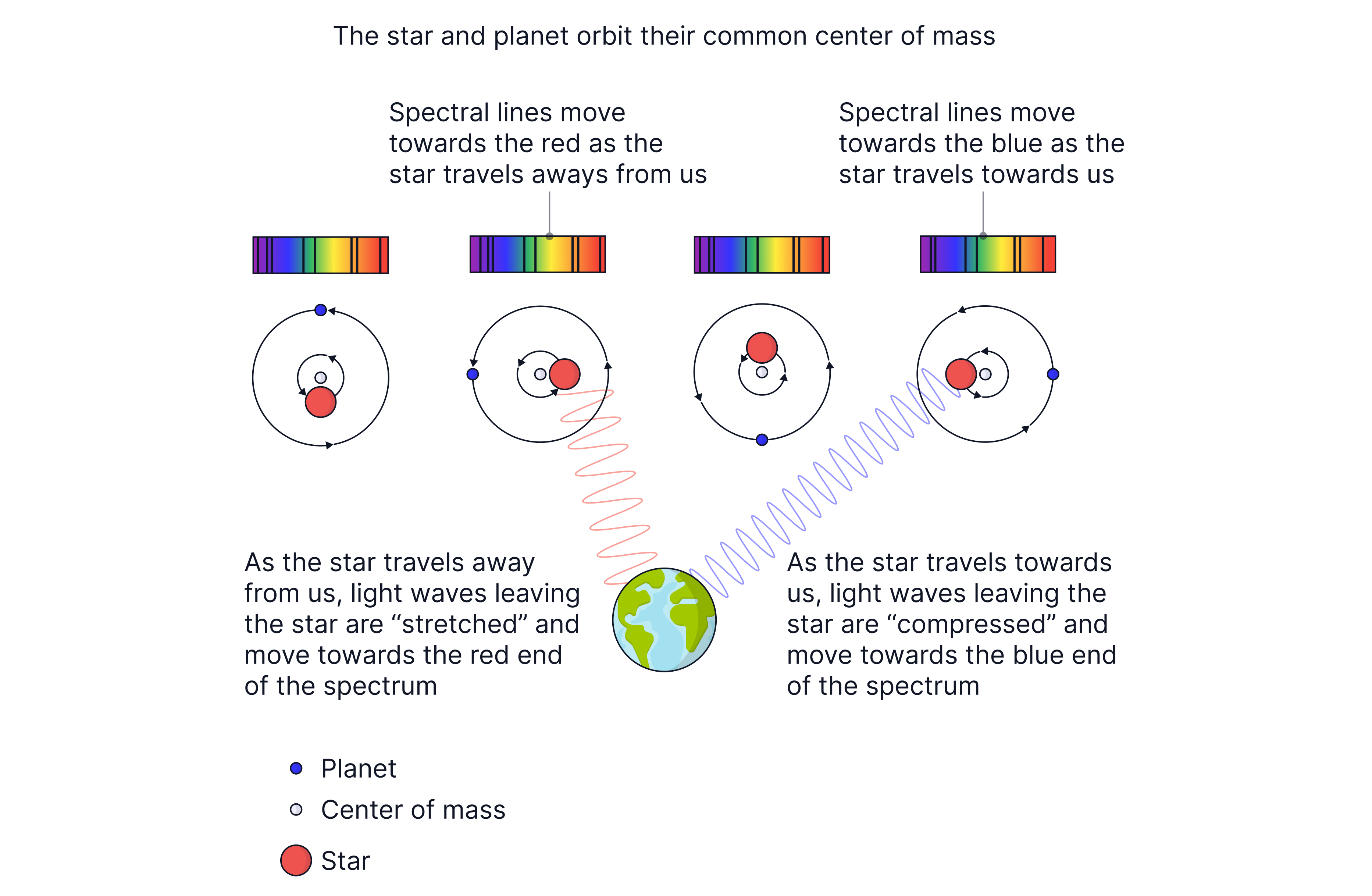
When a planet orbits a star, the gravitational pull causes the star to “wobble”. This can cause a Doppler shift in the light received from the star. If we observe a change in wavelength of a spectral line due to the motion of the star, then we know that it is orbiting a common centre of mass due to planets present in the system.
However, if the mass of the star is significantly larger than the masses of the planets combined, this 'wobble' may be extremely hard to detect.
Transit Method
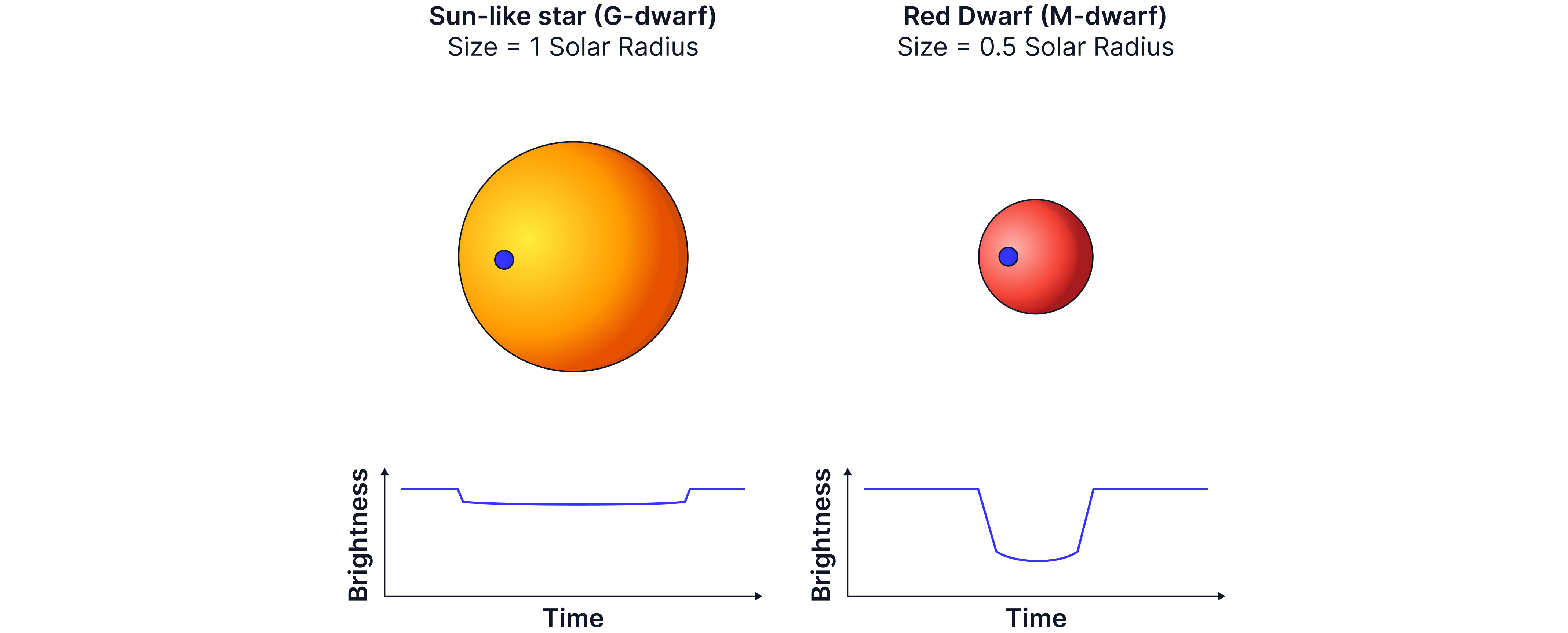
If a planet passes in front of a star, the star's light is dimmed temporarily. We then observe the star, and if a planet passes in front of it due to its orbit, the star's apparent magnitude will dim very slightly.
However, many other processes can cause this dimming in the light curve, such as sunspots or variations in the star's output. Repeated transits are then observed to confirm the existence of a planet. The planet must also orbit the star across our line of sight for the dip in brightness to be detected, which is not always the case.
Practice Question
Over Exoplanets have been discovered, but finding an Earth-like planet orbiting a Sun-like star remains challenging. Explain why.
-> Check out Brook's video explanation for more help
Answer:
One method of observation is the radial velocity method; however, exoplanets similar in size to the Earth are much smaller than their star making the Doppler shift difficult to detect as the centre of mass lies within the star for a Sun-Earth system, as the mass of the Sun is significantly larger than that of the Earth.
The transit method could be used, but if the exoplanet doesn’t orbit in the correct plane, it may not be detected. This method is also very time-consuming, as the period of orbit may be very long.
Direct observation could be used, but if the star is too bright, it can be difficult to observe the exoplanet. Additionally, if the star and exoplanet are too close together, such as the Earth and the Sun, the telescope may be unable to resolve them.