Nuclear Reactor
Brook Edgar
Teacher

Explainer Video
Fossil Fuel Power Plants
Electricity in the UK is generated using a mix of energy resources, with fossil fuels being the primary source in power stations in the past. In these stations, fuel is burned to heat water, producing pressurised steam that then turns turbines. The generator effect occurs here as the rotation of the turbine causes the wires in the generator to rotate around a magnet, producing an induced electromotive force (emf) due to Faraday's Law (see the Magnetic Fields chapter).
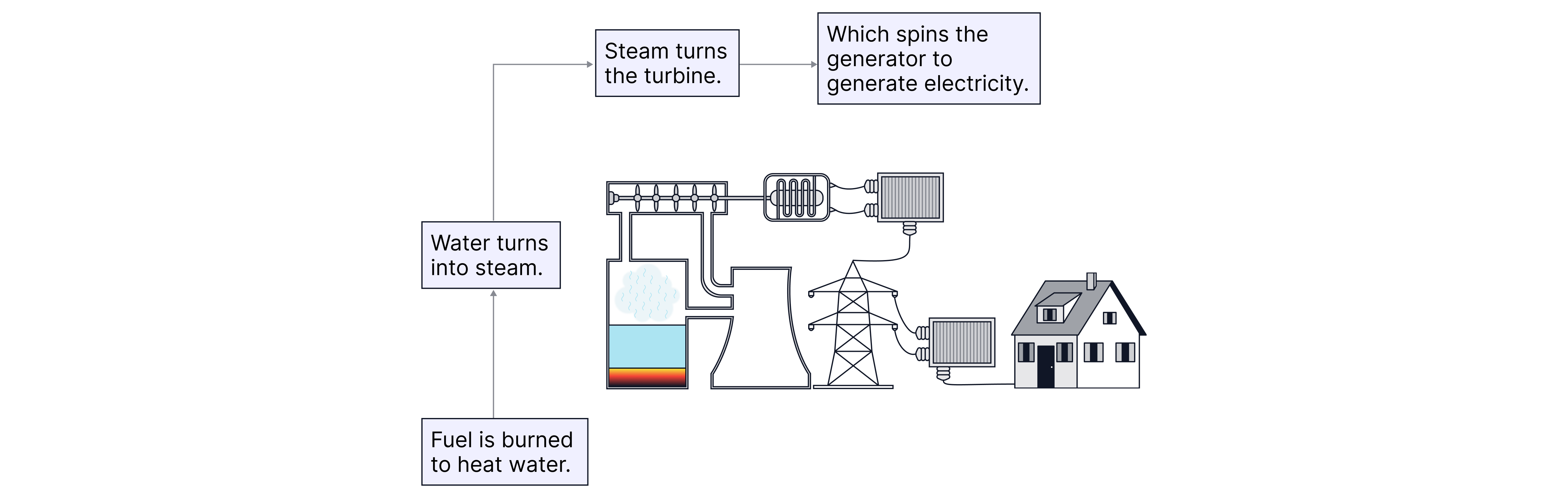
Transformers are used to increase the efficiency of transmission as the potential difference needs to be high so that the current is low. Low current reduces energy loss due to heating in the cables (). All transformers consist of an iron core that connects the primary and secondary coils via a changing magnetic field.
Nuclear Power
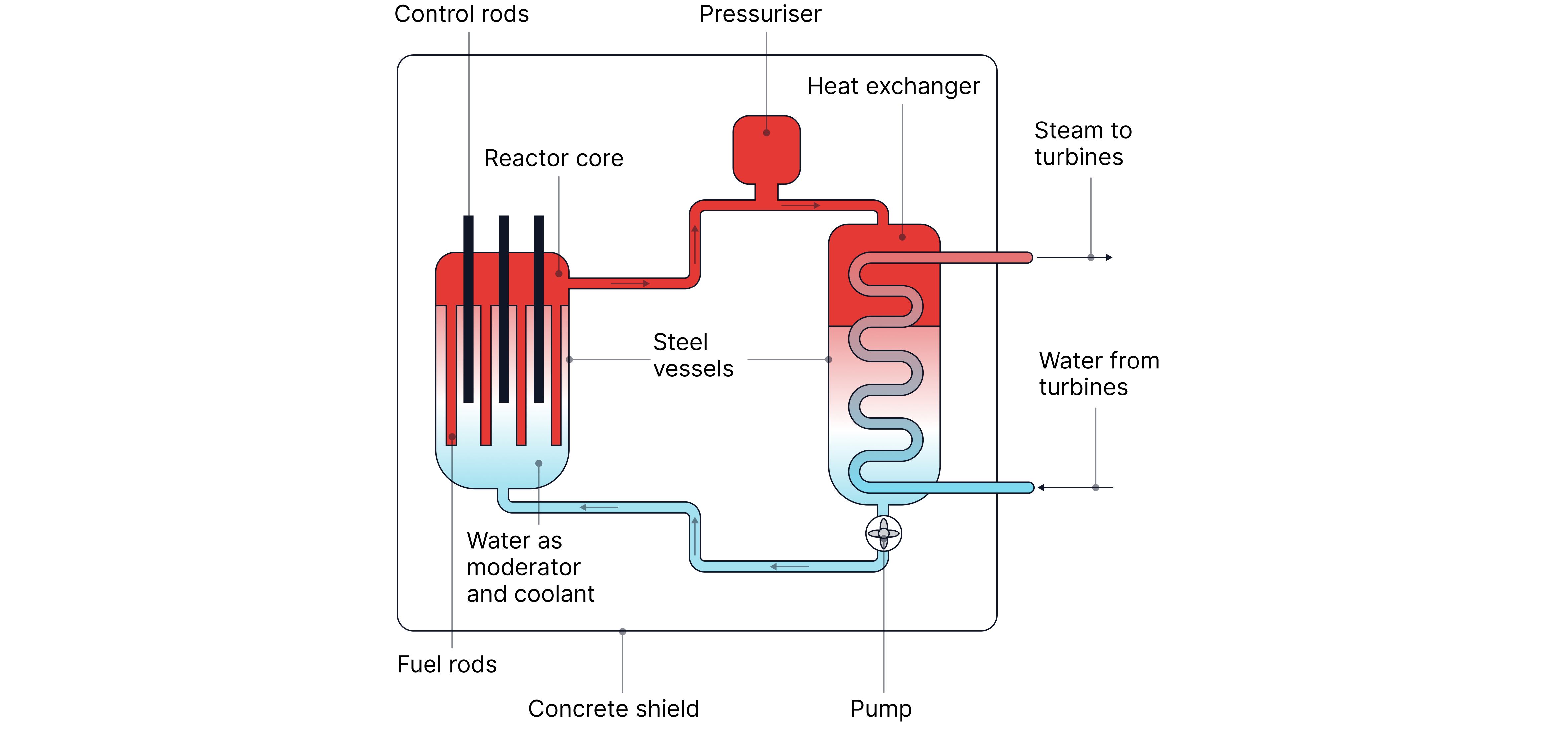
Nuclear power stations provide more energy per kg of fuel than fossil fuel plants. They operate in essentially the same way, except instead of burning fossil fuels to heat water, energy is released from the nuclear fission of Uranium-. The fuel used is enriched uranium containing % more of the fissionable isotope (U-) than found in naturally occurring uranium.
Control rods inside the reactor are necessary to ensure the chain reaction continues at a constant rate without causing melt down. As each fission event releases two or more neutrons, some of these neutrons need to be absorbed to maintain a constant power output -they are absorbed by the control rods. The mass of fissile material is maintained at or just above the critical mass.
For fission to occur, neutrons need to be absorbed by the U- nuclei, however, the neutrons released in each fission event are travelling too fast to be absorbed. The neutrons need to be slowed down, and this is achieved due to the presence of a moderator. The neutrons are slowed down as they collide with the moderator, losing some of their kinetic energy. The moderator is usually made from graphite or water. Once the neutrons are slowed down, they are known as thermal neutrons, and they can now be absorbed by the U- nuclei. As the neutrons travel more slowly, they spend more time inside the reactor, increasing the probability of collision and, consequently, absorption.
The moderator heats up as the kinetic energy lost by the fast-moving neutrons is converted to heat. Therefore, a coolant is needed to carry heat away from the moderator - usually carbon dioxide or heavy water. The coolant should be non-flammable, have the ability to absorb a large amount of heat (have a high specific heat capacity), be non-corrosive, and be a poor neutron absorber.
Advantages of nuclear power:
Do not use fossil fuels
Produce more energy per kg of fuel, thus requiring less fuel for the same output of energy
No direct carbon dioxide/ greenhouse gas emissions during operation
Disadvantages of nuclear power:
The waste is radioactive, which is dangerous and expensive to dispose of
There is a risk of nuclear meltdown
Safety Procedures
Nuclear reactors require numerous safety procedures and precautions due to the highly radioactive waste they produce.
A reactor must have an emergency shutdown system in place to prevent the reaction from getting out of control. If something goes wrong, the control rods are fully inserted, stopping the reaction by absorbing all neutrons.
The core is contained in thick concrete to reduce the escape of gamma rays.
Spent fuel rods are put into cooling ponds.
Radioactive waste is encased in steel containers (to reduce the escape of gamma rays).
High-level waste (e.g. spent fuel rods) is fused into glass so it doesn't leak.
Waste is buried deep underground in geologically stable areas (not near volcanoes or fault lines).
Nuclear waste is handled remotely (using machines) to minimise contact.
Protective clothing worn by employees (lead-lined clothing).
Worked Example
In some thermal nuclear reactors carbon is used as the moderator.
State another material commonly used as a moderator.
State two reasons why neutrons are slowed during fission.
State what happens to a neutron that hits the moderator.
State what happens to a neutron that hits a control rod.
A slow-moving neutron collides with a nucleus, causing fission. Describe the process.
State the source of the radioactive waste produced in a thermal nuclear reactor and discuss how to deal with the waste.
Answer:
Heavy water.
There’s a higher probability of slow neutrons being absorbed by U- as they spend more time inside the reactor. Also, U- can only absorb thermal neutrons (slower-moving neutrons).
The moderator slows down the neutron by colliding with it, causing the neutron to lose kinetic energy. Common moderators: water or graphite.
The neutron is absorbed.
The neutron is absorbed by U-235, and U-236 is formed. It then splits into two lighter nuclei, and more neutrons and energy are released.
The most dangerous source of high-level waste is the spent fuel rods, as the daughter nuclei produced from the decay of U-235 may be radioactive. They should be placed in cooling ponds as they are hot and radioactive. Waste is solidified by fusing it with glass and is then encased in steel containers. The waste is buried deep underground, as the waste may be radioactive for hundreds of years.