Progressive Waves
Brook Edgar
Teacher

Contents
Explainer Video
Introduction to Waves
There are two types of waves, longitudinal and transverse.
Longitudinal waves. The particles oscillate parallel to the direction of energy transfer. An example of a longitudinal wave is a sound wave.

Transverse Waves. The particles oscillate perpendicular to the direction of energy transfer. An example of a transverse wave is an EM wave.

, is the wave equation first introduced at GCSE.
Wave speedfrequencywavelength
Frequency is defined as the number of waves passing a point in one second, measured in hertz , Hz.
Humans can hear between and . Ultrasound is above the range of human hearing, while infrasound is below it.
Wavelength is the length of one complete wave cycle. From compression to compression on a longitudinal wave or from peak to peak or trough to trough on a transverse wave
Amplitude is the maximum displacement of a particle from its equilibrium position.
Time period, , is defined as the time taken for one full cycle or for one full wave to pass.
Worked Example
Calculate the wavelength of an ultrasound wave of frequency travelling through steel. The speed of sound in steel is .
Answer:
.
Worked Example
Oscilloscopes are devices used to display and measure electrical signals that vary with time. They show on a screen how the voltage of a signal changes with time. The horizontal axis represents time, and the vertical axis represents voltage.
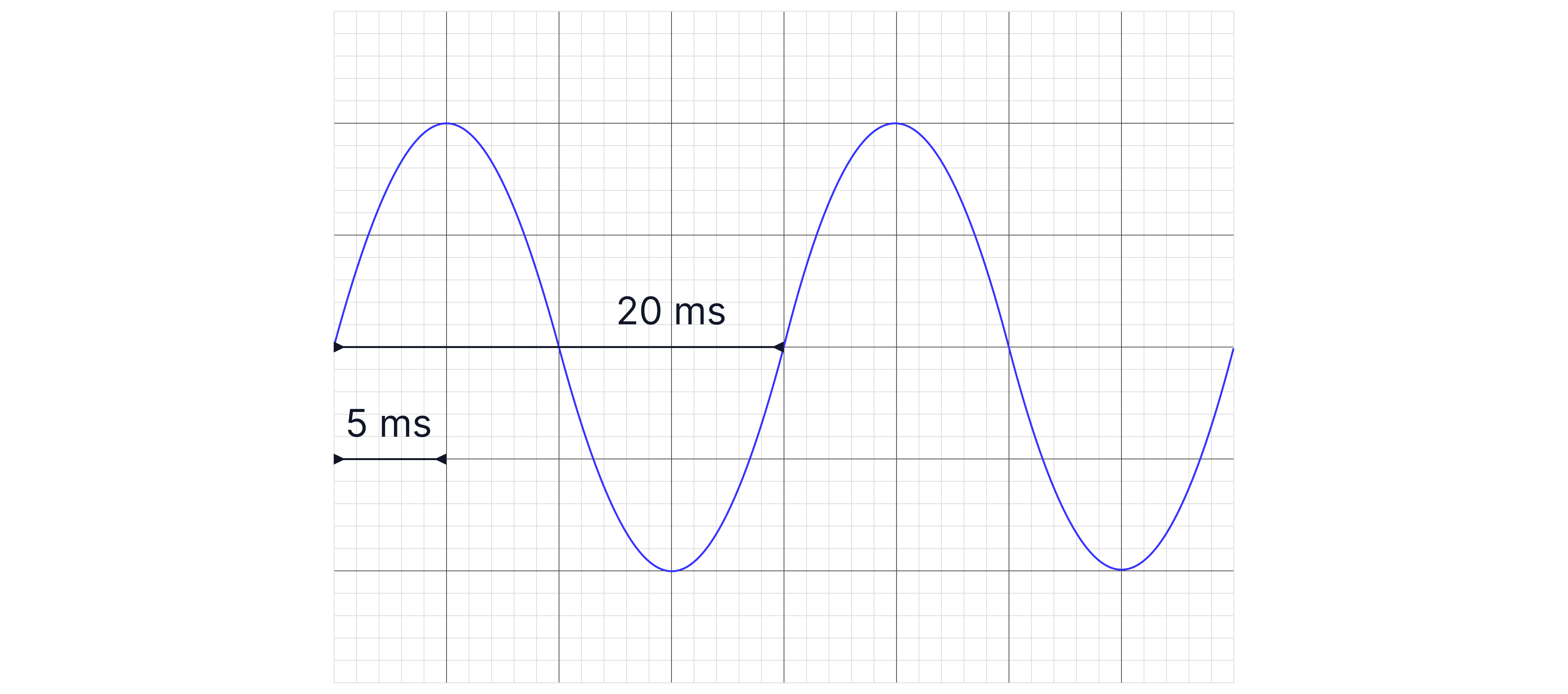
A microphone is connected to an oscilloscope to investigate a sound. The oscilloscope trace is shown below.
On the x-axis, one division represents .
Calculate the frequency of the sound wave.
Answer:
To find the frequency of the wave, we need to find the time period, the time for one full wave, which is four divisions.
Phase and Path Difference
A progressive wave, also known as a travelling wave, transfers energy across space. Like sound waves travelling through air or light waves (EM waves) travelling through space.
The diagram below shows a wave on a rope. We can see that the knot is currently at the equilibrium position.
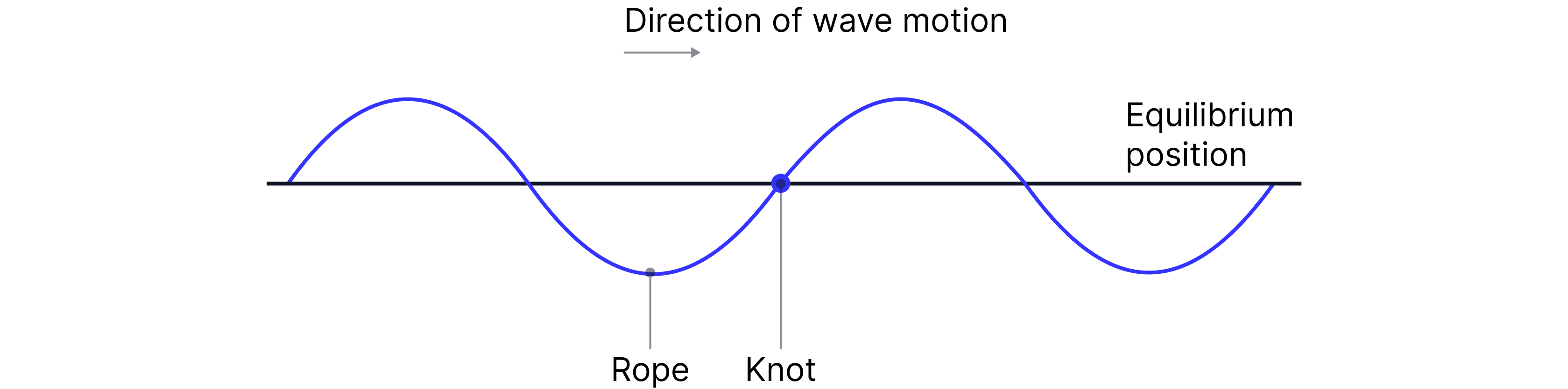 As the wave travels to the right, we can describe how the position of the knot changes with time. To do this, we sketch a wave slightly shifted to the right as the energy of the wave is moving to the right.
Below the dotted purple line shows the wave positions at a later time, we can see that the knot will have shifted down from its equilibrium position. Over one full cycle, the knot will shift down to its maximum negative displacement, then up to its maximum positive displacement, and back down to its equilibrium position.
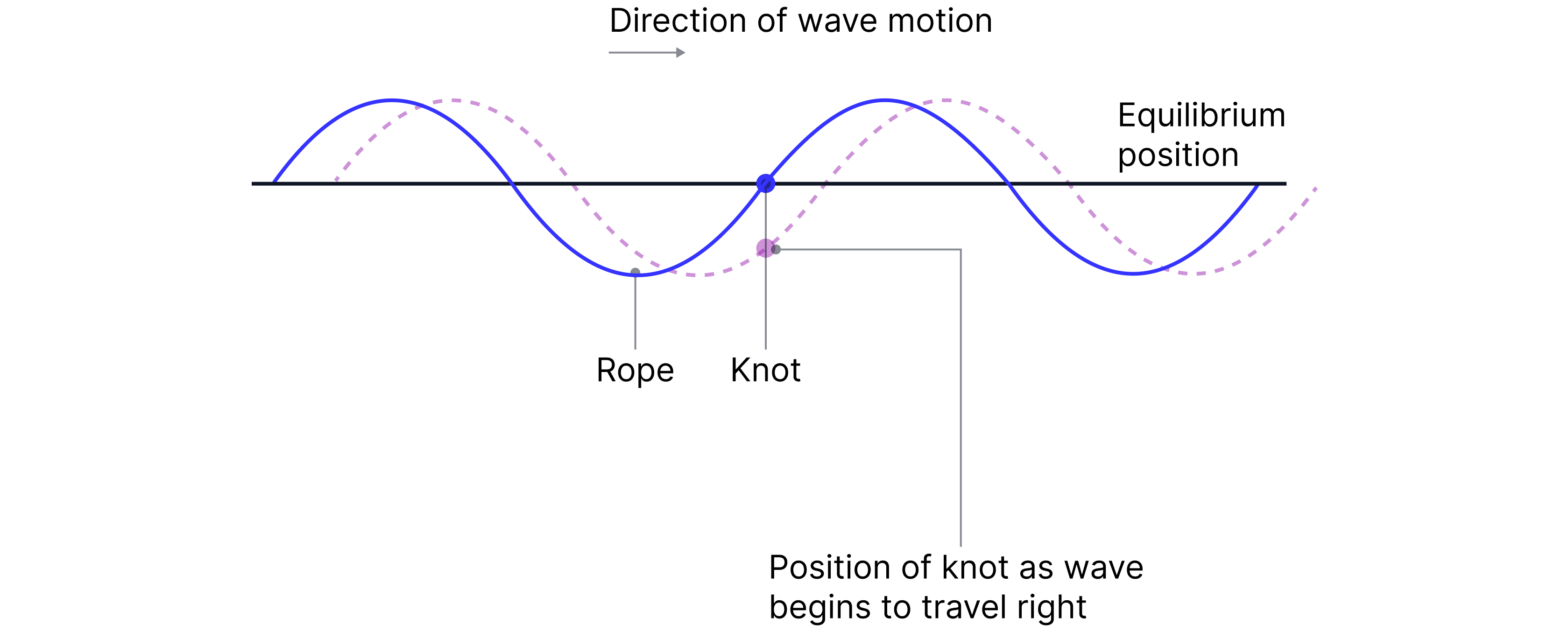
All points in a progressive wave have the same amplitude and frequency, but a different phase as they reach their maximum/minimum displacement at different times.
If two points on a wave are exactly in phase, they oscillate with the same frequency and reach the maximum and minimum displacement at the same time. Therefore, in a progressive wave, points that are a whole number of wavelengths apart are in phase.
The phase difference between two waves or two points on the same wave is a measure of what fraction of a whole wave cycle one point is ahead of the other, measured in radians or degrees.
This is not on the equation sheet. You need to remember this.
For example, if two waves both have a wavelength of but one wave is ahead of the other, to calculate the phase difference we do the calculation below,
Worked Example
In diagram X, both waves have a wavelength of . They both start at the slits, and in phase.
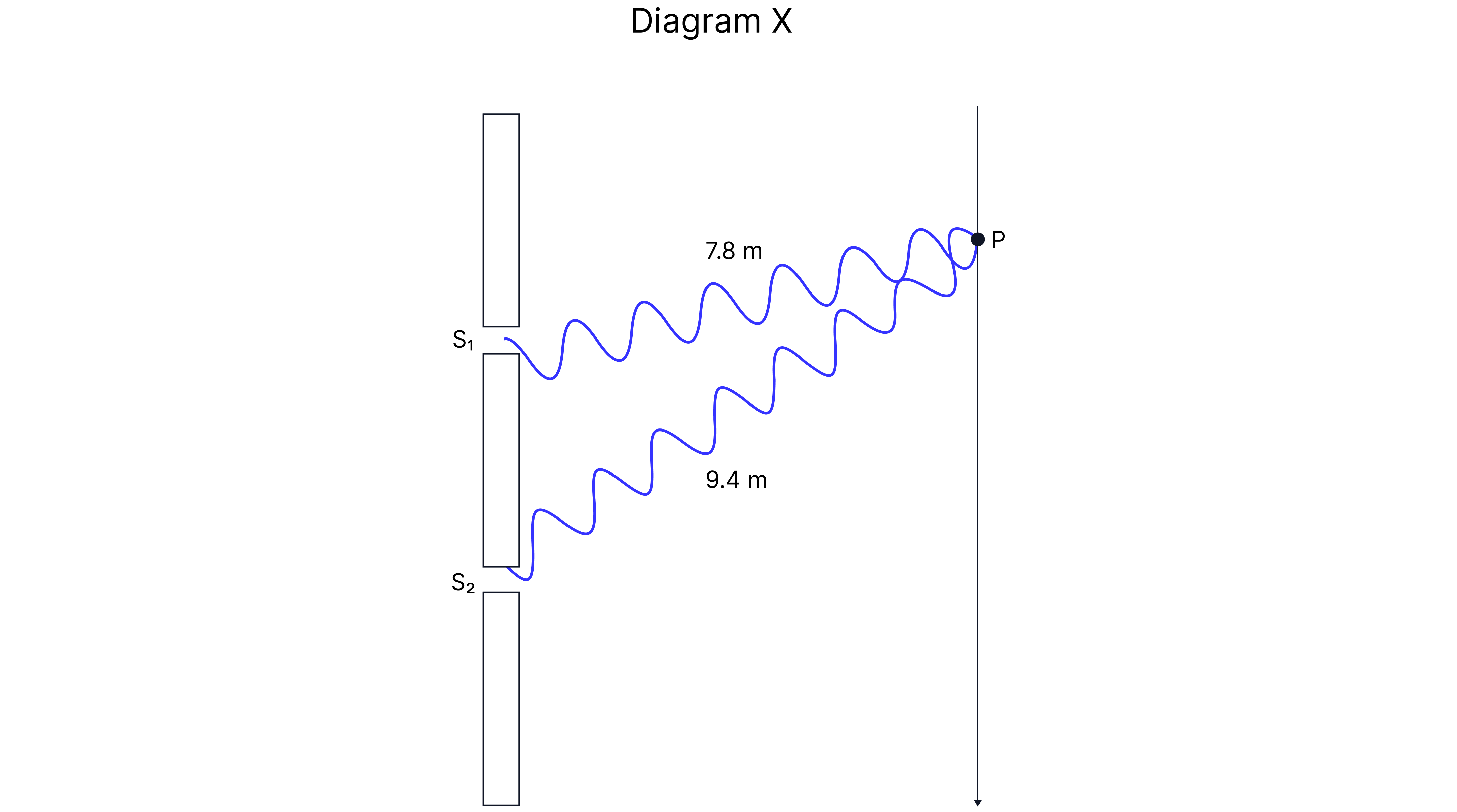
Calculate the phase difference at point in radians.
Answer:
The waves travel a different distance. The wave leaving slit two travels further than the wave from slit one. This is the path difference.
Polarised waves
Unpolarised light oscillates in many planes. Polarised waves oscillate in one plane only.
Waves can be polarised using polarisers, or they can be partially polarised by reflections from surfaces.
Electromagnetic waves oscillate at right angles to the direction of energy transfer in all orientations.
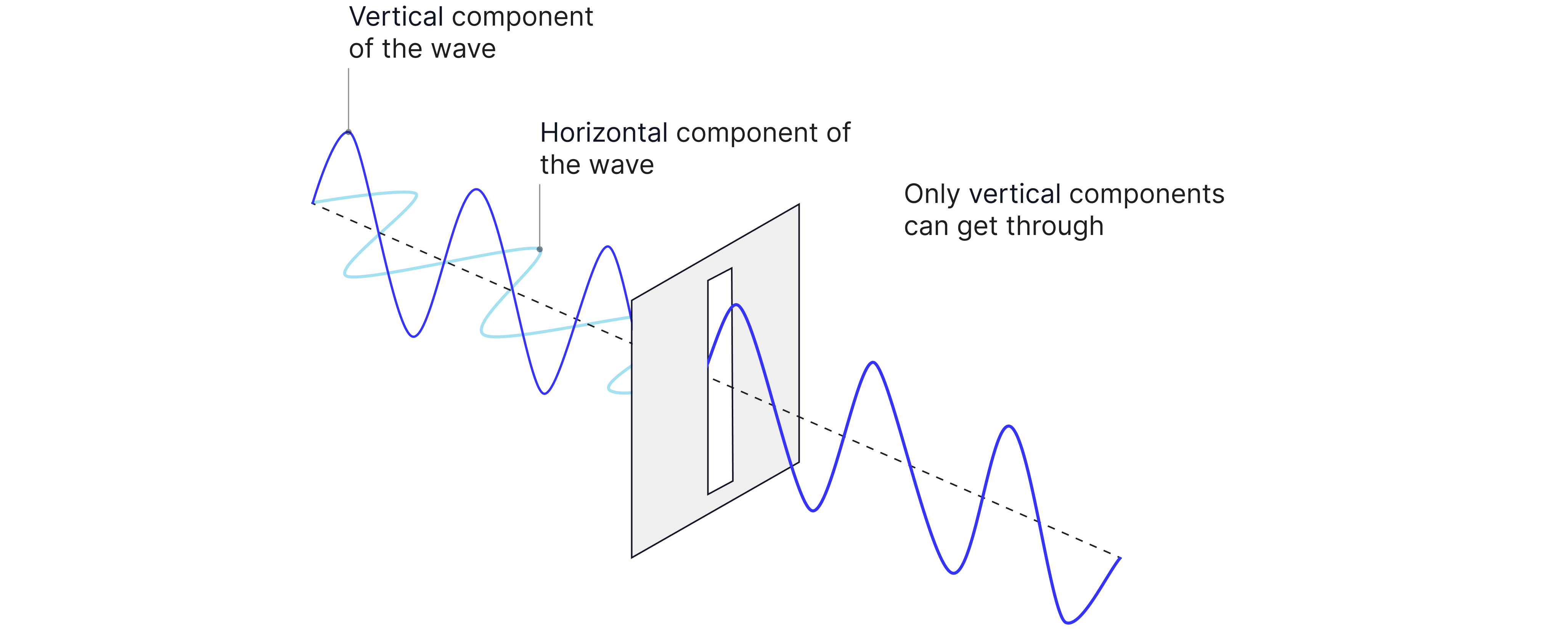
All the oscillations can be resolved into their horizontal and vertical components.
A vertical polariser absorbs all components of the wave except the vertical components, allowing only the vertical components through. The wave intensity is halved because half of the wave is absorbed by the polarising filter.
Only transverse waves can be polarised as the oscillations are perpendicular to the direction of energy transfer.
Longitudinal waves cannot be polarised as the direction of oscillation and propagation are the same, so there is no perpendicular direction to filter.
If a second polariser is placed in the same orientation as the first, all light will pass through, but if rotated through , to become perpendicular to the orientation of the first polariser, the intensity of light received by the observer will decrease to zero.
To check to see if a wave has already been polarised, you rotate a polariser through . If the light is extinguished twice on rotation, then the wave was polarised. ( once at and once at )
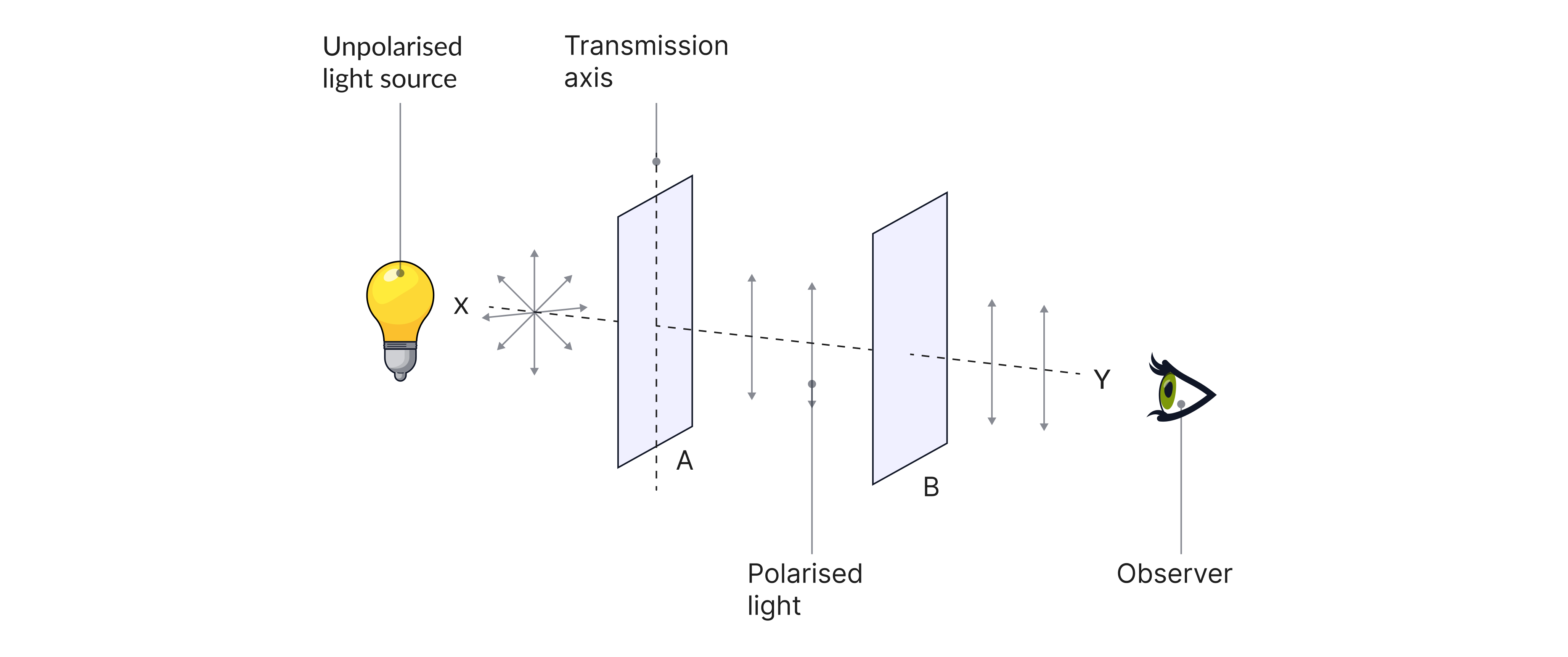
Plane polarisation only allows components of waves orientated in the same direction (oscillating in the same plane) to pass through.
Practice Questions
A wave is ahead of another identical wave. Calculate the phase difference between the two waves. Both waves have a wavelength of .
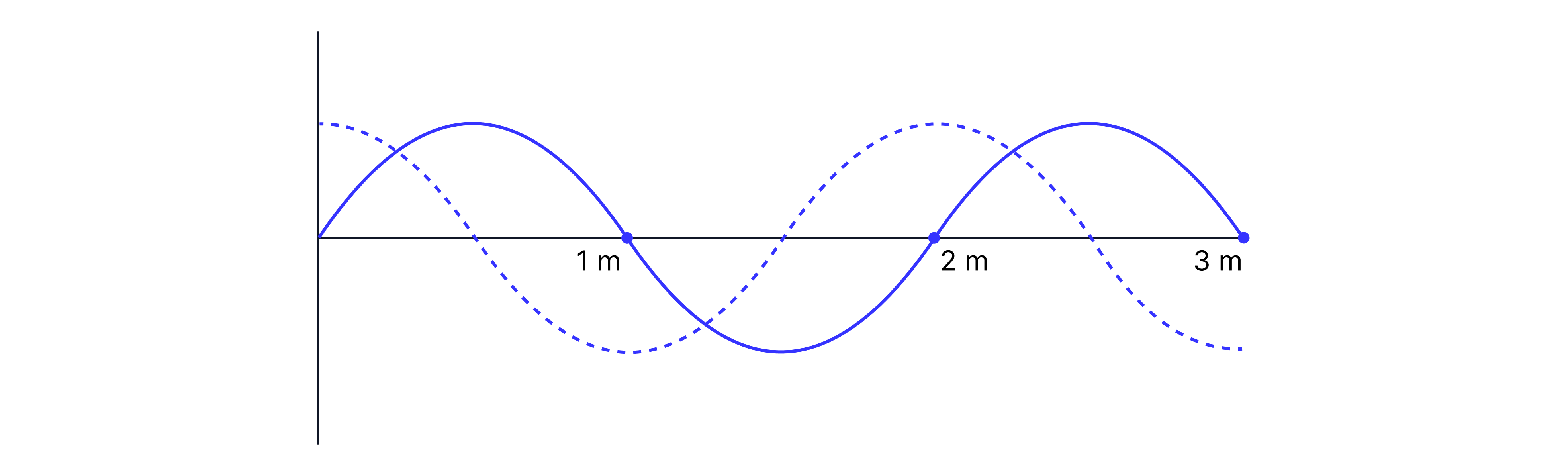
Using the diagram below, calculate the phase difference between the two waves, one is dashed, the other is a solid line.
-> Check out Brook's video explanation for more help.
Answer:
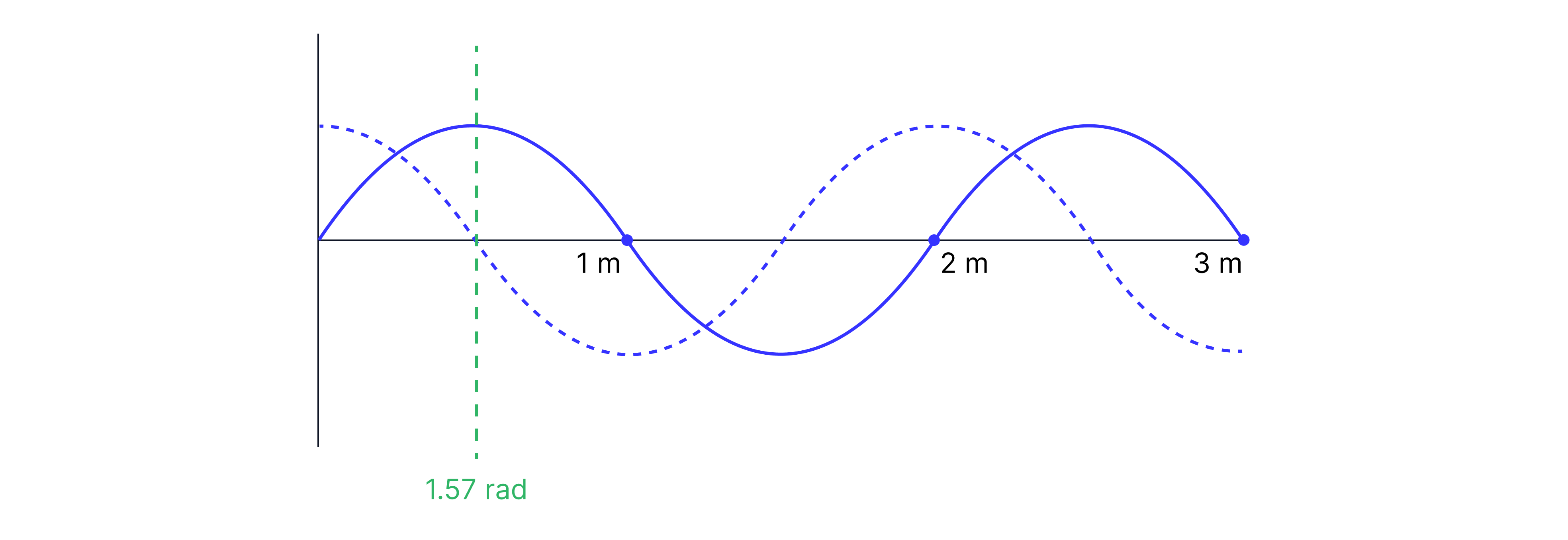
Both waves have a phase difference of or radians.
The progressive, transverse wave shown in the diagram below has a frequency of .
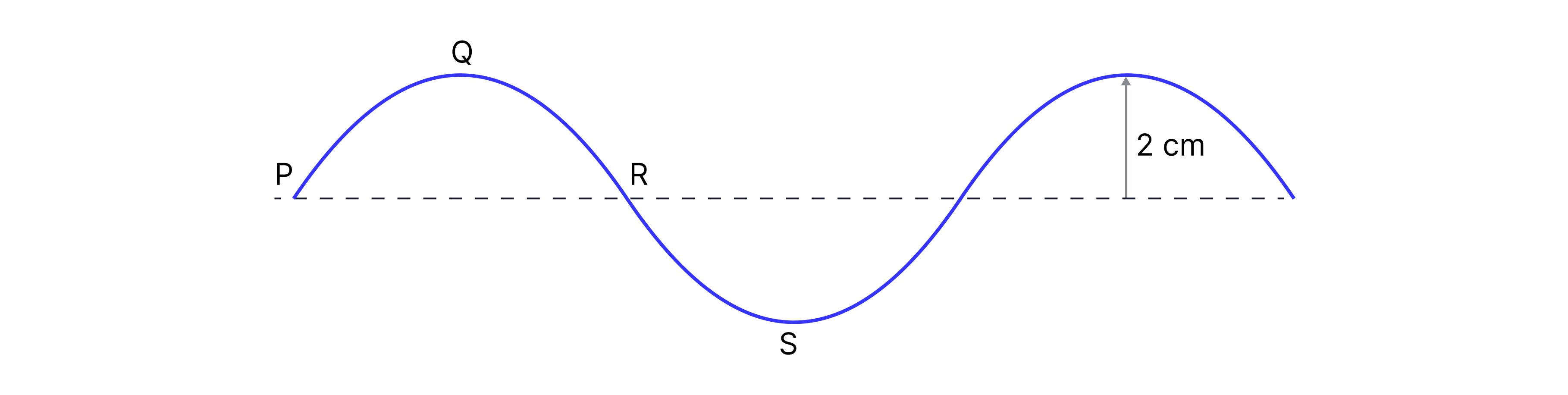
Choose the one correct statement from the options below.
The phase difference between point P and point S is rad.
P and R are in phase.
The particle velocity is a maximum at Q
-> Check out Brook's video explanation for more help.
Answer:
A