Single Slit Diffraction
Brook Edgar
Teacher

Explainer Video
Introduction to the Single Slit Experiment
In a single slit, an interference pattern is formed as each point in the slit acts as a secondary source of waves. This is due to Huygens' principle, which you do not need to know, but is explained below to push your understanding.
According to Huygens' principle, every part of the wavefront in the slit emits wavelets. These are like rays that start out in phase and head in all directions. Assuming the screen is very far away compared with the size of the slit, rays heading toward a common destination are nearly parallel. When they travel straight ahead, they remain in phase, and a central maximum is obtained. However, when rays travel at an angle relative to the original direction of the beam, each travels a different distance, and they can arrive in or out of phase, giving constructive or destructive interference.
We can imagine that a single slit is made of an infinite number of point sources of waves that all diffract, producing an interference pattern on the screen.
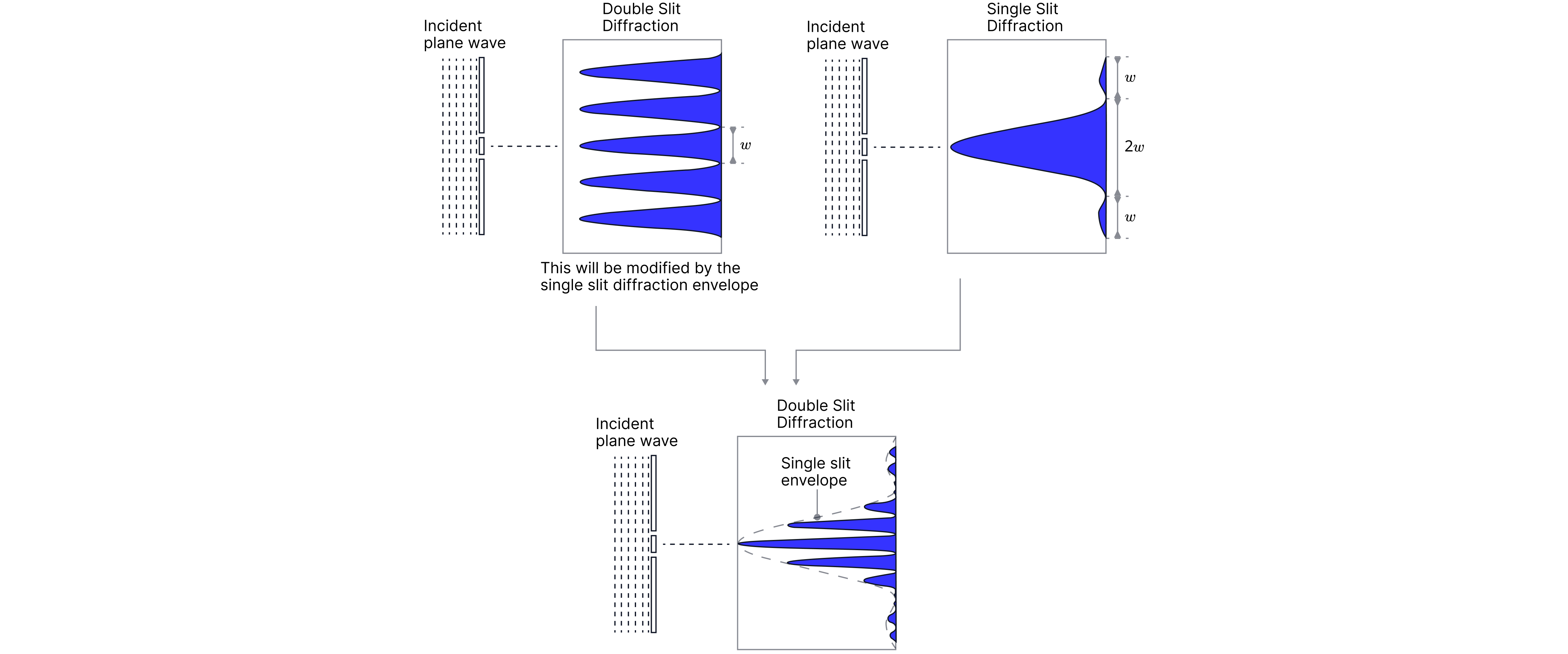
The interference pattern produced on screen is formed of alternating bright and dark fringes, similar to the double slit experiment. However, the central maximum is twice the width of the other fringes with a greater intensity.
If each fringe spacing, , then the width of the central maximum is two times this, , where is the width of the single slit gap.

The actual pattern from a double slit is then a combination of the patterns from the single slit and double slit experiments, but you will not get asked to draw this, it is just here for reference.
Worked Example
Using a laser, a single slit diffraction pattern is produced on a screen.

Sketch how the intensity varies across the screen to the right of the central maximum.
A laser is a source of monochromatic, coherent light. Define the two terms.
Light of a longer wavelength is used. Describe how the pattern changes.
If the slit was made narrower, state how the fringes appear differently.
The laser is now replaced with a lamp. Sketch and label the appearance of the fringes as you would see them on a screen.
Answer:
Frings are reduced in intensity and have half the width.
Monochromatic -> Light of a single wavelength.
Coherent -> waves of the same wavelength/frequency and a constant phase difference.
, increasing increases the fringe spacing . The fringes are wider/further apart.
, decreasing slit width, increases fringe spacing , making fringes wider.
Red light has a longer wavelength, so the fringe separation would be greater. Violet has a shorter wavelength, so the fringe separation would be smaller. Light from the lamp will be made of many different wavelength.
We then observe a spectrum on the fringes, with red on the outside and violet on the inner. The central maximum is white, as the path difference here is zero.
Practice Questions
A single, narrow slit is illuminated with monochromatic light. The slit width is increased.
State what happens to the width and brightness of the central maximum.
-> Check out Brook's video explanation for more help.
Answer:
The central maximum will become narrower as less diffraction/spreading out of the waves occurs. The central maximum would get brighter as more light can pass through a wider gap.