Classification of living organisms and the binomial system
Laura Armstrong & Joe Wolfensohn
Teachers


Recall Questions
This topic requires prior knowledge of classification and species.
What is a species?
Organisms that can interbreed to produce fertile offspring.
What are the 5 kingdoms?
Animal, plant, fungi, protist and prokaryote (bacteria).
What are the differences between plant cells and animal cells?
Plant cells have a cell wall made of cellulose, a large vacuole and often chloroplasts. Animal cells do not have these structures.
Topic Explainer Video
Check out this @JoeDoesBiology video that explains classification of living organisms and the binomial system, then read the study notes. Once you’ve gone through them, don’t forget to try the practice questions!
Why Do We Classify Living Things?
-
To organise and understand biodiversity
-
There are millions of species on Earth. Classification helps us group them in a logical way, making it easier to study and understand them.
-
To show evolutionary relationships
-
Organisms that are similar in structure or genetics are likely to share a common ancestor. Classification helps us see how species are related through evolution.
-
To make predictions
-
If an organism is classified in the same group as others, we can predict characteristics it might share (e.g., diet, habitat, behaviour).
The Linnaean Classification System
-
Developed by Carl Linnaeus in the 1700s.
-
Organisms are sorted into seven different levels known as taxa (plural). Each level is called a taxon (singular).
-
Kingdom
-
Phylum
-
Class
-
Order
-
Family
-
Genus
-
Species
-
This hierarchy goes from larger, broader groups to smaller, more specific ones.
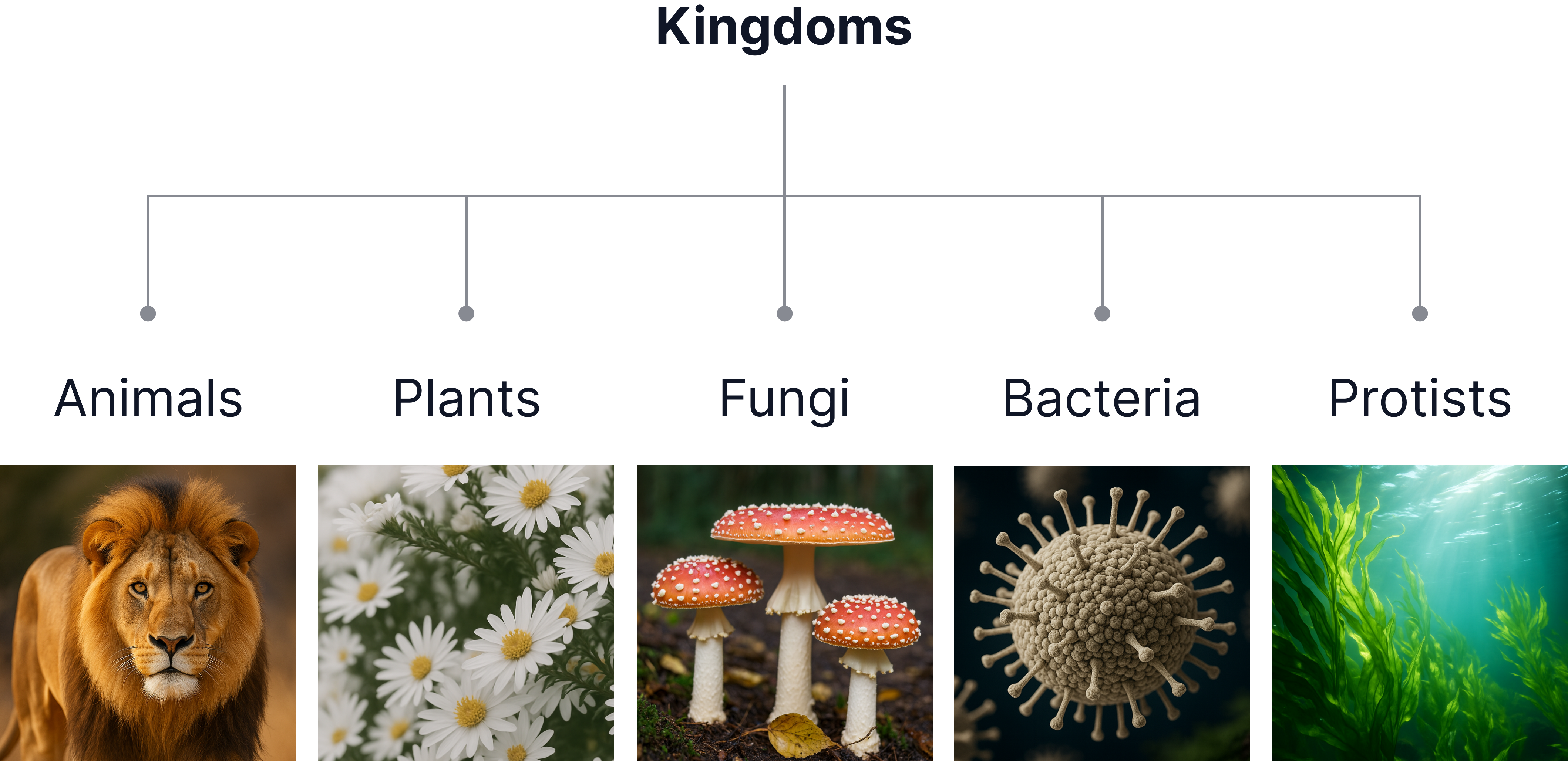
There are five different kingdoms, as shown below:
The Binomial Naming System
-
This was also developed by Carl Linnaeus.
-
Each organism is given a two-part Latin name:
-
First part = The Genus (capitalised) to which they belong
-
Second part = Their individual species name (lowercase)
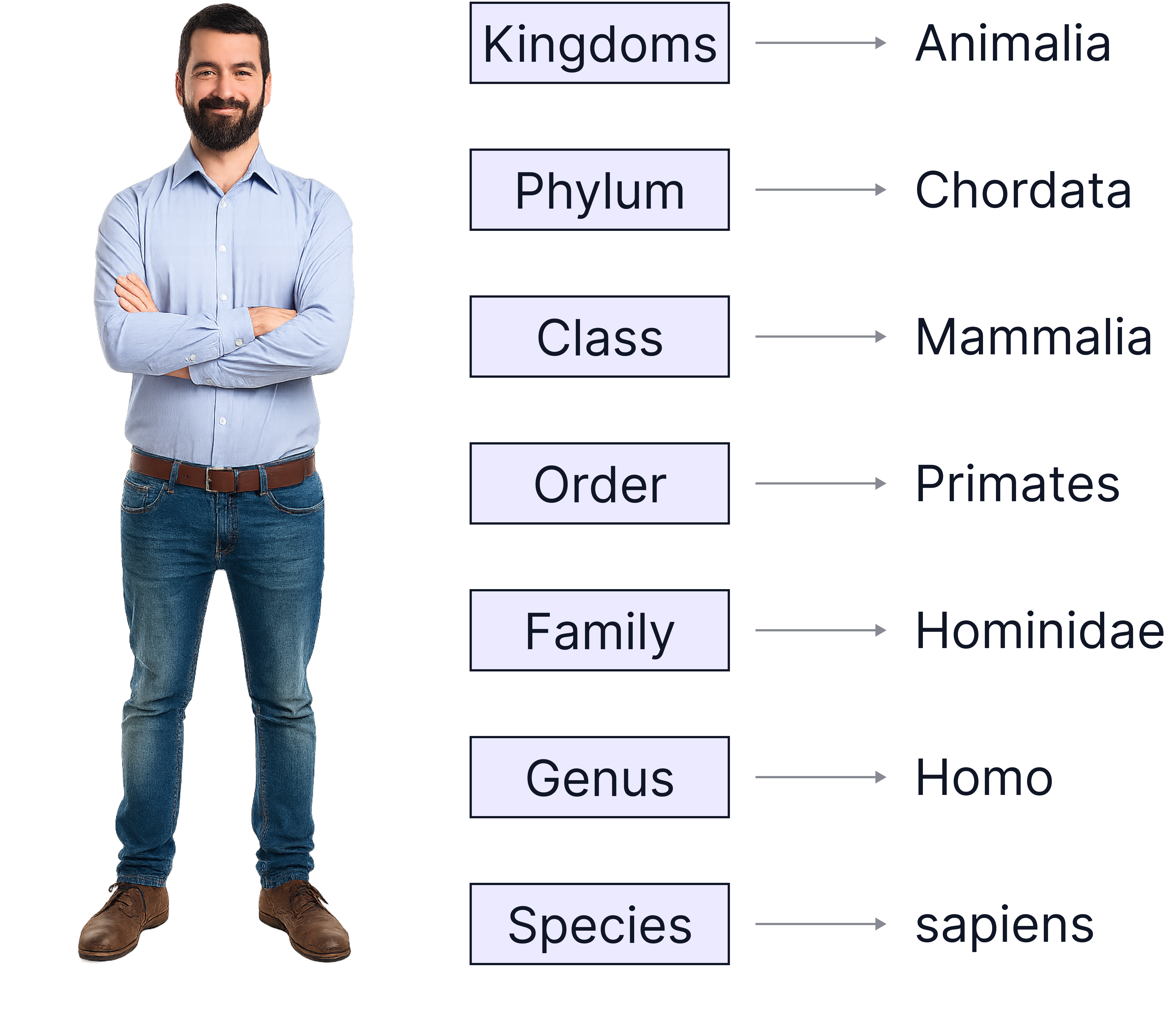
Example 1: The human is in the animal kingdom and our scientific name is Homo sapien.
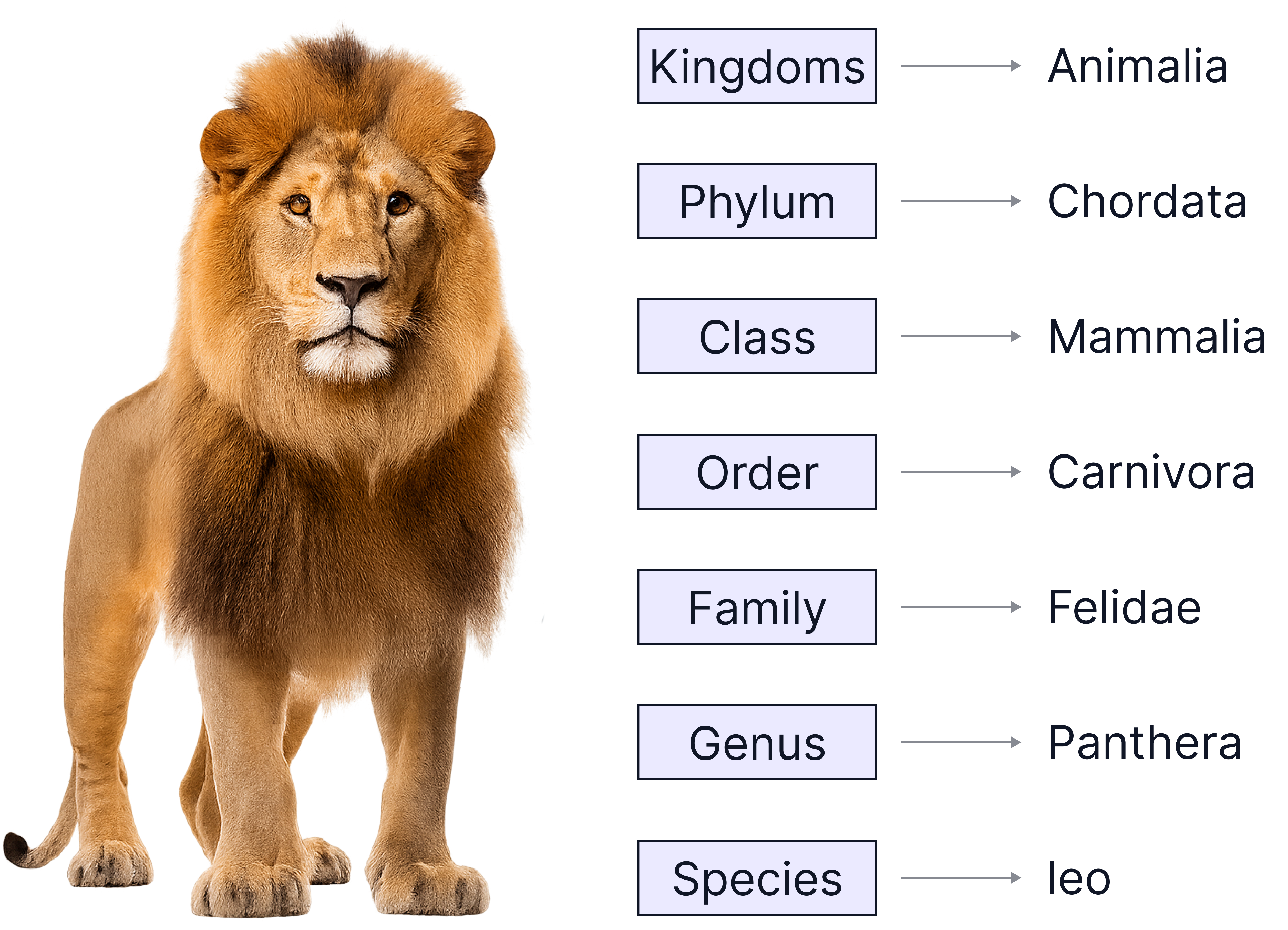
Example 2: The lion is in the animal kingdom and its scientific name is Panthera leo.
This scientific naming system avoids confusion caused by different languages and different common names used around the world.
We can also learn more about evolutionary relationships from the two part name. For example, two animals with the same genus name must belong to the same genus and are therefore more closely related. The lion, Panthera leo, and the tiger, Panthera tigris, belong to the same genus and share a recent common ancestor.
Key Terms
-
Classification – Grouping organisms by similarities in characteristics or genes.
-
Binomial system – The two-part scientific naming system using genus and species.
-
Carl Linnaeus – Scientist who developed the traditional classification system.
No answer provided.
Exam Tip
Always capitalise the genus and use lowercase for the species in scientific names.
Use the pneumonic King Prawn Curry Or Fat Greasy Sausages to remember the order of the taxa in the classification hierarchy!
No answer provided.
Practice Question
Living organisms can be classified into groups.
Trilobites are animals that lived in the sea 400 to 500 million years ago.
The table below gives the classification of two species of trilobite.
|
Classification group |
Trilobite A |
Trilobite B |
|
|
Animalia |
Animalia |
|
Phylum |
Arthropoda |
Arthropoda |
|
Class |
Trilobita |
Trilobita |
|
Order |
Ptychopariida |
Ptychopariida |
|
Family |
Alokistocaridae |
Marjumiidae |
|
|
Elrathia |
Modocia |
|
Species |
kingii |
typicalis |
a) Complete the table above (2 marks)
b) Give the scientific name of trilobite B (1 mark)
c) Who developed the naming system used in your previous answer? (1 mark)
a) Kingdom
Genus (in this order only)
b) Modocia typicalis
c) Carl Linnaeus
More Practice
Try to answer these practice questions from the TikTok videos on your own, then watch the videos to see how well you did!