Tissues in a leaf
Laura Armstrong & Joe Wolfensohn
Teachers


Contents
Recall Questions
This topic requires prior knowledge of the structure and function of plant cells, including specialised cells.
What is the function of a chloroplast?
To absorb light energy for photosynthesis.
Name two features of a root hair cell and explain how they help its function.
Long extension - increases surface area to absorb more water and minerals.
Many mitochondria - to provide more energy for active transport.
What is the function of xylem cells?
To transport water and mineral ions from the roots to the leaves.
Topic Explainer Video
Check out this @JoeDoesBiology video that explains tissues in a leaf, then read the study notes. Once you’ve gone through them, don’t forget to try the practice questions!
The Leaf as a Plant Organ
The leaf is an organ made up of several specialised tissues, each with a specific function to support photosynthesis, gas exchange, and transport.
Plant Tissues and Functions in the Leaf:
|
Tissue |
Function |
|
Waxy cuticle |
Transparent, impermeable layer. Prevents water loss but allows light through. |
|
Upper epidermis |
Transparent layer that lets light through; may secrete a waxy cuticle to reduce water loss. |
|
Palisade mesophyll |
Tightly packed cells near the upper surface of the leaf. They contain many chloroplasts to absorb light energy - the main site of photosynthesis. |
|
Spongy mesophyll |
Loosely packed cells with air spaces to aid rapid gas diffusion. |
|
Xylem |
Transports water and mineral ions up from the roots and into the leaf. |
|
Phloem |
Transports sugars (products of photosynthesis) away from the leaf to all other parts of the plant. |
|
Lower epidermis |
Contains guard cells and stomata for gas exchange. |
Guard Cells and Stomata
-
Guard cells control the opening and closing of stomata. They close the stomata at night when CO₂ is not needed for photosynthesis. They can also close the stomata to prevent too much water loss via evaporation, for example, during the hottest part of the day.
-
Stomata allow CO₂ in and O₂ out (gas exchange), and water vapour to exit during transpiration.
-
CO₂ is needed by plant cells for photosynthesis.
-
O₂ is produced by photosynthesis. Some may be used for respiration but some may diffuse out via the stomata when the rate of photosynthesis is higher than the rate of respiration.
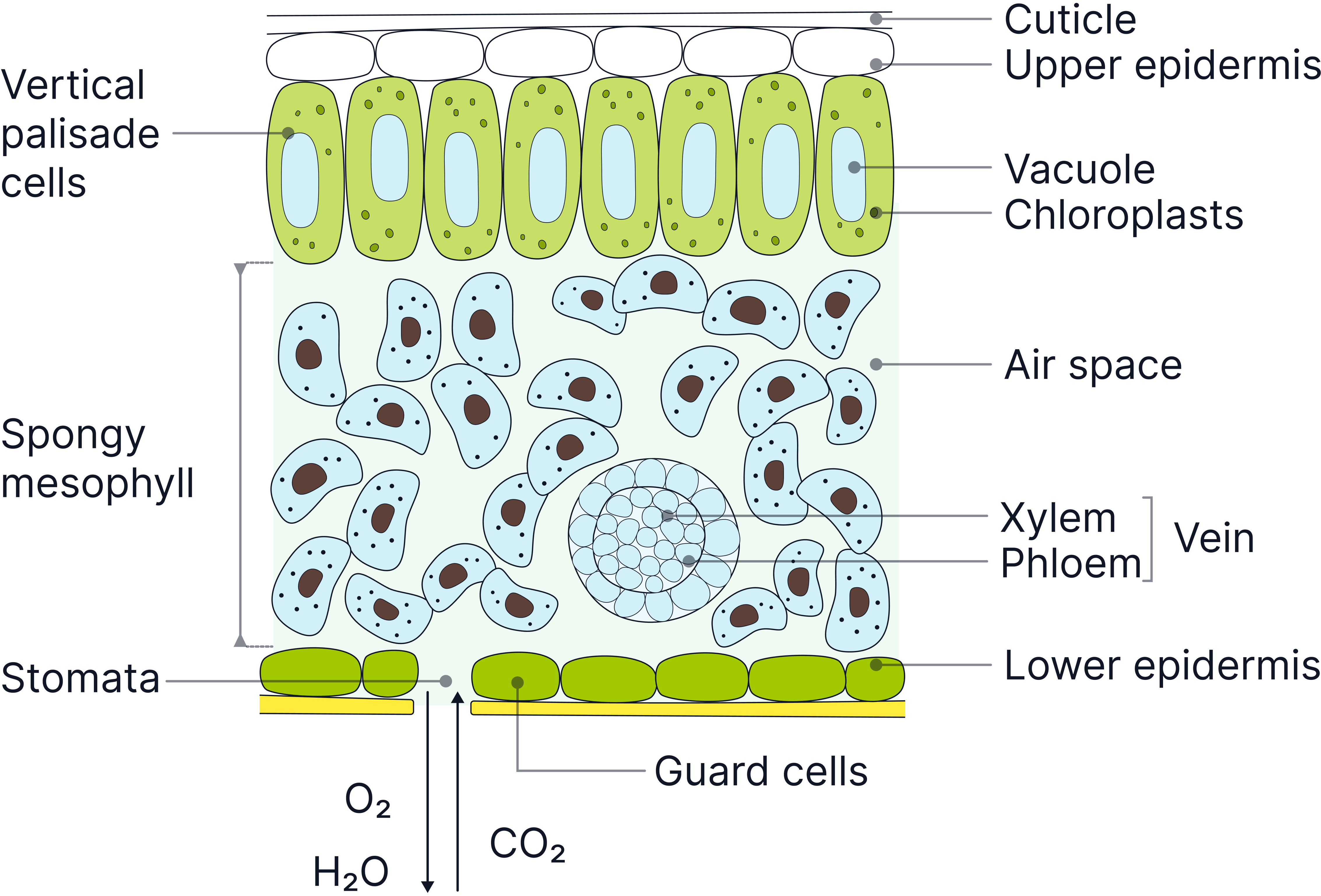
Cross section of a leaf.
Maths Skill – Calculating the Number of Stomata
Example Question:
A student counts 15 stomata in a field of view. Estimate the number of stomata per mm².
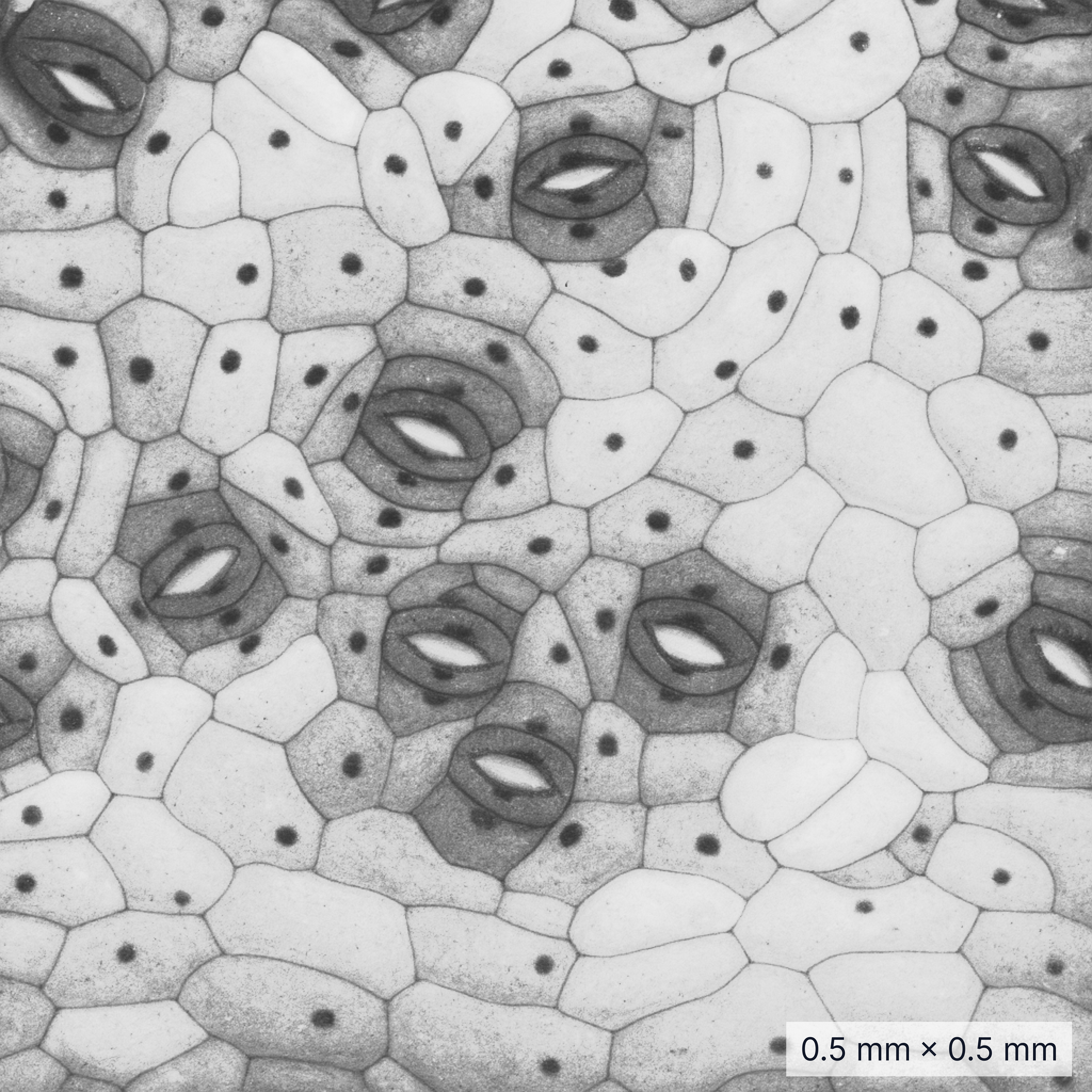
Step 1: Find number per mm²
Area viewed = 0.5 x 0.5 = 0.25 mm2
Stomata per mm² = stomata counted ÷ area viewed
Stomata per mm² = 15 ÷ 0.25 = 60 stomata per mm²
Key Terms
-
Epidermis - The top and bottom layer of the leaf.
-
Stoma (plural: stomata) – pore for gas exchange.
-
Guard cells – specialised cells that open and close stomata.
No answer provided.
Exam Tip
In ‘explain’ questions, always link structure to function (e.g. palisade cells have lots of chloroplasts to absorb more light energy).
No answer provided.
Practice Question
Explain how the structure of the leaf is adapted for efficient gas exchange and photosynthesis. (4 marks)
Any four from:
-
The leaf is thin and has a larger surface area to maximise diffusion of gases and absorb light energy.
-
The palisade mesophyll layer has many chloroplasts and is near the surface to maximise light absorption.
-
The spongy mesophyll layer has air spaces to allow gases to diffuse quickly.
-
Stomata allow carbon dioxide to enter the leaf and oxygen to exit.
-
Guard cells control water loss by opening and closing stomata.
More Practice
Try to answer these practice questions from the TikTok videos on your own, then watch the videos to see how well you did!