Alpha, Beta & Gamma Radiation
Brook Edgar
Teacher

Contents
Explainer Video
Ionisation Chamber
To determine the type of radiation emitted by a source, an ionisation chamber, cloud chamber, or Geiger tube can be used.
An ionisation chamber consists of air at atmospheric pressure that becomes ionised due to the radioactive source. The ions formed are then attracted to the oppositely charged electrode inside the chamber, where they are discharged. This creates a flow of electrons around the circuit which is recorded.
The current is proportional to the number of ions created per second in the chamber.

Worked Example
State which type of radiation would produce the highest current.
Describe if we can compare the ionisation of alpha and beta if the source is from the chamber.
Explain how gamma radiation is dependent on distance.
Answer:
Alpha – the most ionising type of radiation, produces the most ion pairs per of air.
No, we can't, as alpha has a short range, approximately in air, therefore it would not reach the ionisation chamber.
Gamma radiation is a photon/electromagnetic wave; the intensity of the radiation from a source decreases with distance, following the inverse square law, .
Cloud Chamber
A cloud chamber allows us to compare alpha and beta radiation. When a charged particle passes through the chamber, it ionises the gas inside along its path. The ions formed serve as nucleation points where the vapour condenses, forming tiny droplets. These droplets form a visible path that corresponds to the trajectory of the particle. The path is essentially a "cloud" that marks where the particle travelled through the chamber.
Alpha particles are relatively large and have a higher charge; they ionise the air more intensely over a short distance. This creates a thick, straight path that is short because alpha particles lose energy quickly.
Beta particles are smaller, with less charge, so they ionise the air less intensely but over a longer distance. Their paths are thinner, longer, and often more erratic due to scattering.
Worked Example
The image below shows tracks observed in a cloud chamber. Two types of particle tracks, labeled A and B, are visible.
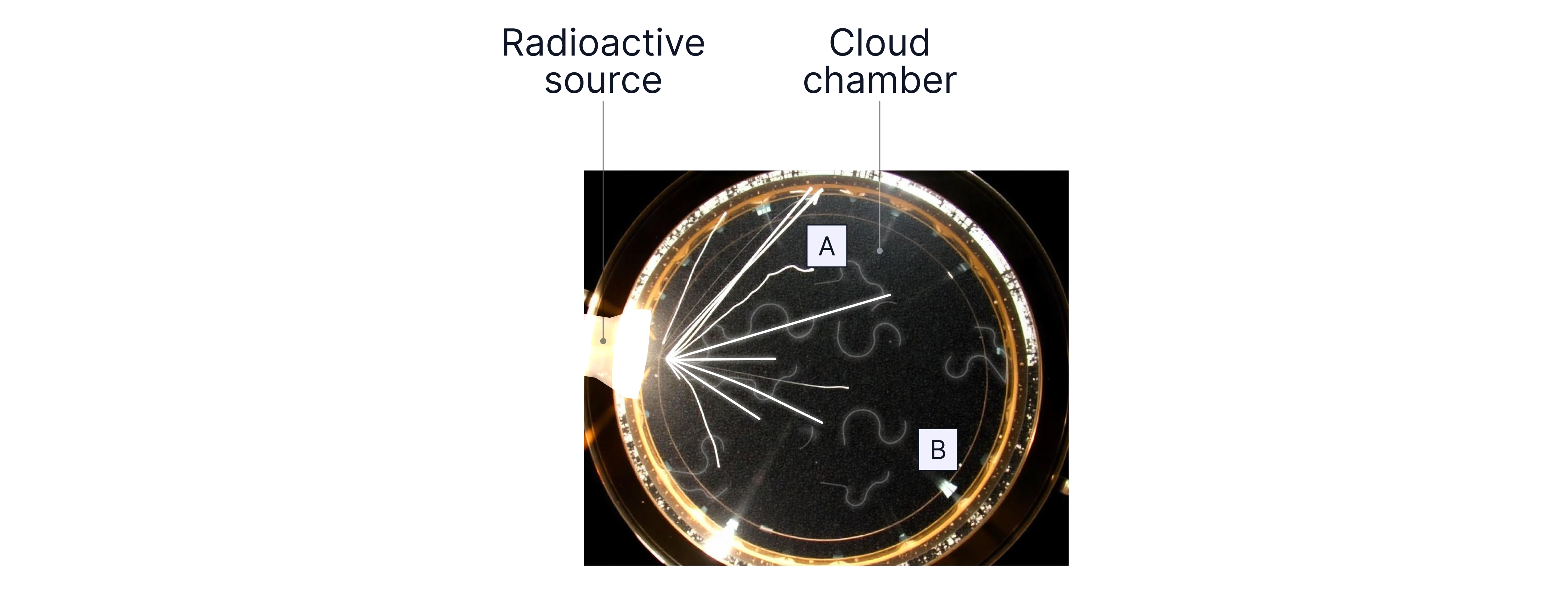
Identify the particles associated with tracks A and B. Justify your answer based on the characteristics of the tracks.
Explain the differences in the ionisation and penetration abilities of the particles that produce tracks A and B.
If a particle-antiparticle pair were produced in the cloud chamber, and a magnetic field was applied across the cloud chamber, how would their paths differ?
Answer:
Beta particles are smaller and have a lower charge than alpha particles, so they can travel further.
Line A = Alpha particles
Line B = Beta particles
Line A -> most ionising, alpha is the most ionising radiation so has low penetration ability.
Line B -> more penetrating, but not as ionising, produces fewer ion pairs per unit of distance, so can travel further before all of its energy is absorbed.
The force on a moving charged particle due to a magnetic field is given by the equation, . The force on the particle is perpendicular to the velocity, resulting in circular motion. Particle and antiparticles have the same mass but opposite charge, resulting in them moving in opposite directions. Direction found by using Fleming's left-hand rule.
Geiger Tube / GM Tube
A Geiger tube contains argon gas at low pressure and a thin window at the end to allow alpha and beta particles through (gamma photons can enter through the tube wall as well). A metal rod down the middle of the tube is at a positive potential, and the tube wall is connected to the negative terminal. When incoming radiation ionises the gas, the negative ions are attracted to the positive rod (anode) and the positive ions to the tube walls (cathode).
A pulse of charge passes around the circuit, causing a voltage pulse across the resistor, which is detected as a single count by the counter.
The problem is dead time, which is the time it takes between an ion hitting the anode and the count being recorded. If another ion strikes the anode during this time, the count will not be recorded.

Remember: Don't PANIC: Positive is Anode, Negative Is Cathode.
Worked Example
A radioactive source decays by emitting alpha, beta and gamma radiation. The student wishes to investigate if the count rate due to the gamma radiation varies with distance from the source according to the inverse square law.

Explain the method they should take, the safety measures they should ensure and any potential sources of error.
Answer:
Method
When no source is in the room, record the background radiation over a long time ( mins to hour)
Place the source from the counter and take a reading over several minutes.
Adjust the distance, increasing the seperation and record the new count rate.
Safety measures
Use tongs when handling the source.
Don’t point the source at anyone.
Keep the source in a lead-lined box when not in use.
You should stand behind shielding when the source is out of the box.
Potential errors
Background reading not recorded over a long enough period to account for random decay.
Inaccurate distances measured as it is hard to know where source is exactly in the box and where ionisation in the tube occurred.
Dead time of the GM tube.
Worked Example
Surgical instruments are often sterilised by exposure to radiation.
Explain which type of radiation is most likely to be used for the sterilisation of metallic surgical instruments.
Explain why people don’t need to worry that irradiated surgical instruments will become radioactive once sterilised.
A pupil measures the count rate for different distances, , from the source. Show that the data in the table below is not consistent with the inverse-square law. You may use the blank columns for your working.
Distance / | Corrected Count Rate / counts per minute | Blank column | Blank column |
Suggest two possible reasons why the results do not follow the inverse-square law.
Answer:
Gamma, because it is the most penetrating type of radiation. The instruments can be sterilised still in their packet.
The nucleus of the atoms that make up the instrument is unchanged. These nuclei will not become radioactive.
In order to prove an inverse square relationship, that , we need to prove that that equals a constant at least three times.
Distance / | Corrected Count Rate / counts per minute | ||
is not constant.
The source may also be emitting alpha or beta radiation. These types of radiation do not follow the inverse square law. Alternatively, the recorded values for distance could be too low because we do not know exactly where ionisation occurred inside the tube. A third reason could be that the background count rate was not recorded for long enough.
Practice Questions
Which row is correct for , , and radiation.
A | Is deflected by a magnetic field | ✓ | ✓ | X |
B | Is deflected by an electric field | ✓ | ✓ | ✓ |
C | Has a positive charge | ✓ | X | ✓ |
D | Comes from outside the nucleus | X | ✓ | X |
-> Check out Brook's video explanation for more help.
Answer:
Row A
In a cloud chamber, straight tracks around long are seen. When the source is from a Geiger tube a count rate is detected. When aluminium is placed between the source and the detector, the count rate falls to zero. What radiation is emitted by the source?
-> Check out Brook's video explanation for more help.
Answer:
C