Work, Energy & Power
Brook Edgar
Teacher

Explainer Video
The Law of Conservation of Energy
Energy cannot be created or destroyed, only transferred from one form to another.
Below are some key equations you need to memorise as they are used throughout physics. They are given in the formula booklet, but to be able to answer harder problems you need to have a bank of equations in your head so you know where to start.
Kinetic Energy is the energy an object has due to its motion.
Formula:
Elastic Potential Energy is the energy stored in a stretched or compressed object.
Formula:
Gravitational potential energy is the energy stored due to an object's position above the ground.
Formula:
Work done is the energy transferred when a force moves an object in the same direction.
Formula:
Worked Example
Calculate the work done in the diagram below. The box is moved by a force of , in the direction shown.

Answer:
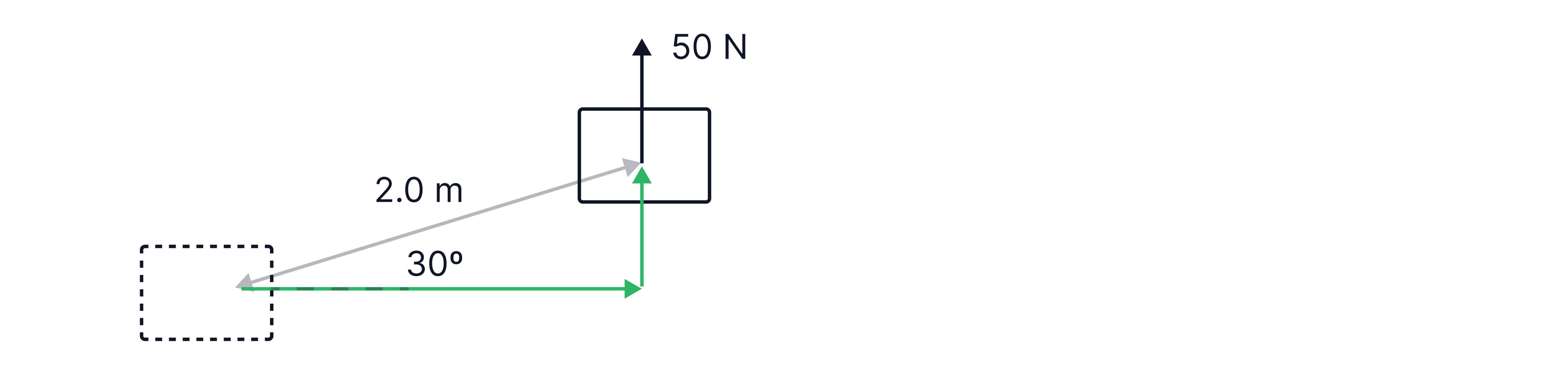
The force is upwards, so we want to find the vertical component of the distance travelled in order to calculate the work done, as the force and distance used must be parallel.
Teacher Tip: We need to find the vertical component of the distance as this is how far the object has travelled in the direction of the force. You can use trigonometry to resolve the distance or always remember when you go through the angle to use and against it .
Worked Example
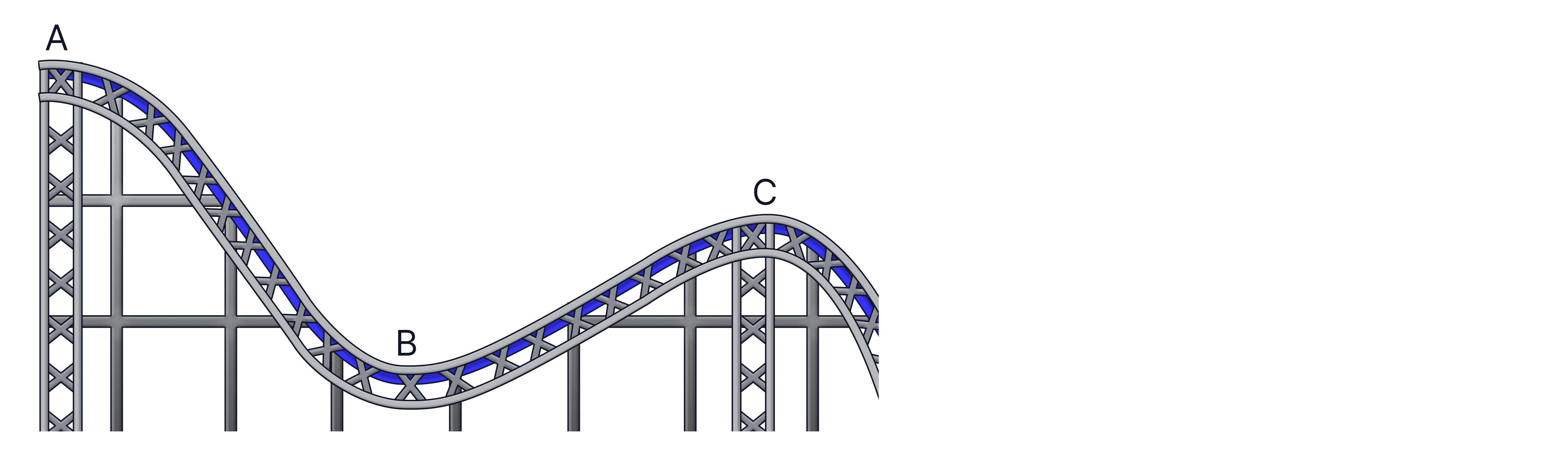
A rollercoaster has a maximum height of at point A and has a mass of . It is stationary at point A. Calculate the velocity at C, which is above the ground. How accurate is this calculation?
Answer:
As the ride is not moving at point A, the ride only has gravitational potential energy. However, at point C, the ride will have both gravitational potential energy due to its height above the ground and kinetic energy due to its motion. Due to the conservation of energy, we will assume that all of the gravitational potential energy at A is converted into gravitational potential energy and kinetic energy at point C.
This is not an accurate calculation as some of the initial total energy will be dissipated into the surroundings due to friction and air resistance. The actual speed at C will be lower than that calculated.
Practice Questions
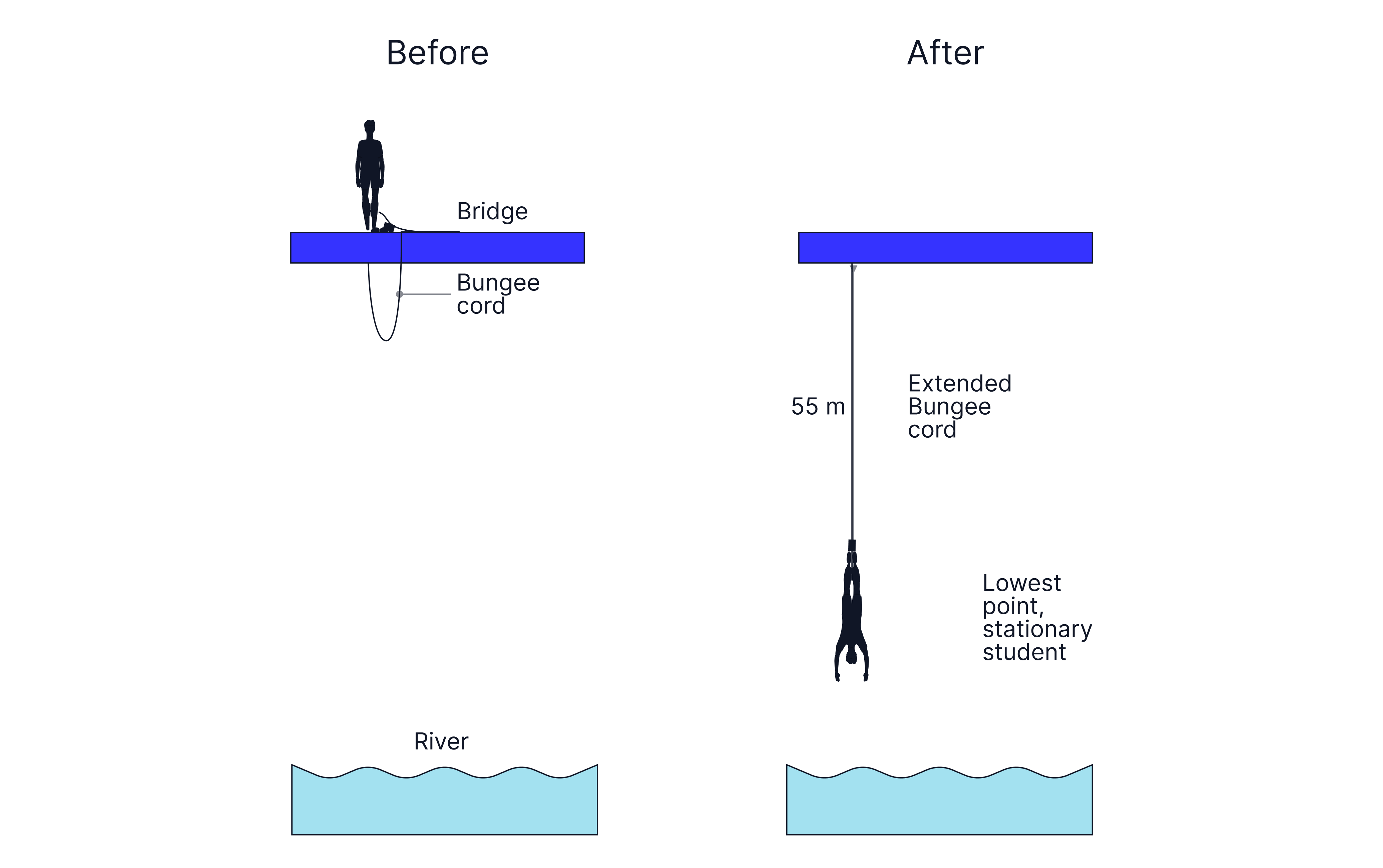
A bungee cord’s unstretched length is . A person with a mass of , who is attached to the bungee cord, jumps. The image below shows him at his lowest point, below the top, where he is stationary.
Calculate the spring constant of the bungee rope.
Calculate the velocity of the person below the bridge.
-> Check out Brook's video explanation for more help.
Answer:
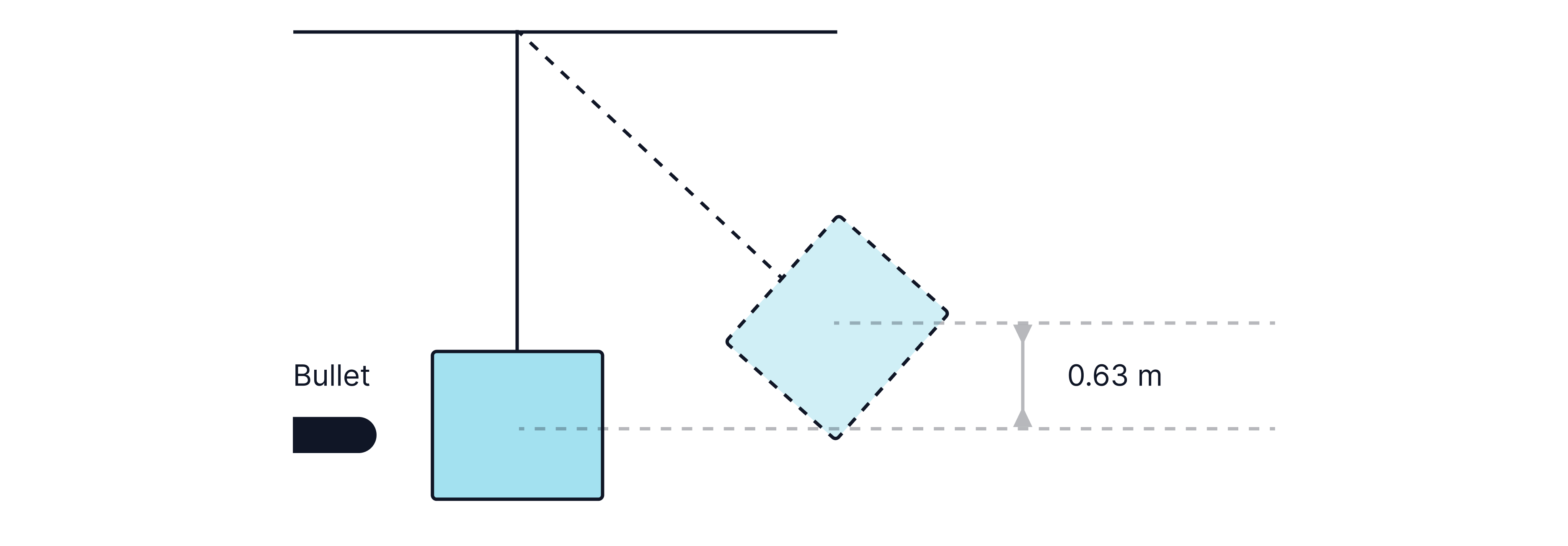
The speed of a bullet is found by firing it into a wooden block suspended from a rigid support. The block is initially stationary. When a bullet, mass , gets embedded into it, the centre of mass of the block rises . The mass of the block is . Calculate the bullet's initial speed.
-> Check out Brook's video explanation for more help.
Answer:
Initial speed =