Triple Science Only - ADH and the kidney (Higher Tier)
Laura Armstrong & Joe Wolfensohn
Teachers


Recall Questions
This topic requires prior knowledge of the kidneys and their role.
What is the main function of the kidneys?
To filter the blood and remove urea, excess water, and mineral ions in urine.
What is selective reabsorption?
It is the process where useful substances like glucose, some water, and some mineral ions are reabsorbed back into the blood in the kidneys.
What is urea and where is it produced?
Urea is a waste product made in the liver from the breakdown of excess amino acids.
Topic Explainer Video
Check out this @Lauradoesbiology video that explains ADH and the kidney, then read the study notes. Once you’ve gone through them, don’t forget to try the practice questions!
Water Balance & the Role of ADH
To maintain a constant internal environment, the body must regulate water content. This is done using the hormone ADH (antidiuretic hormone).
How ADH Works
-
ADH is produced by the pituitary gland in the brain.
-
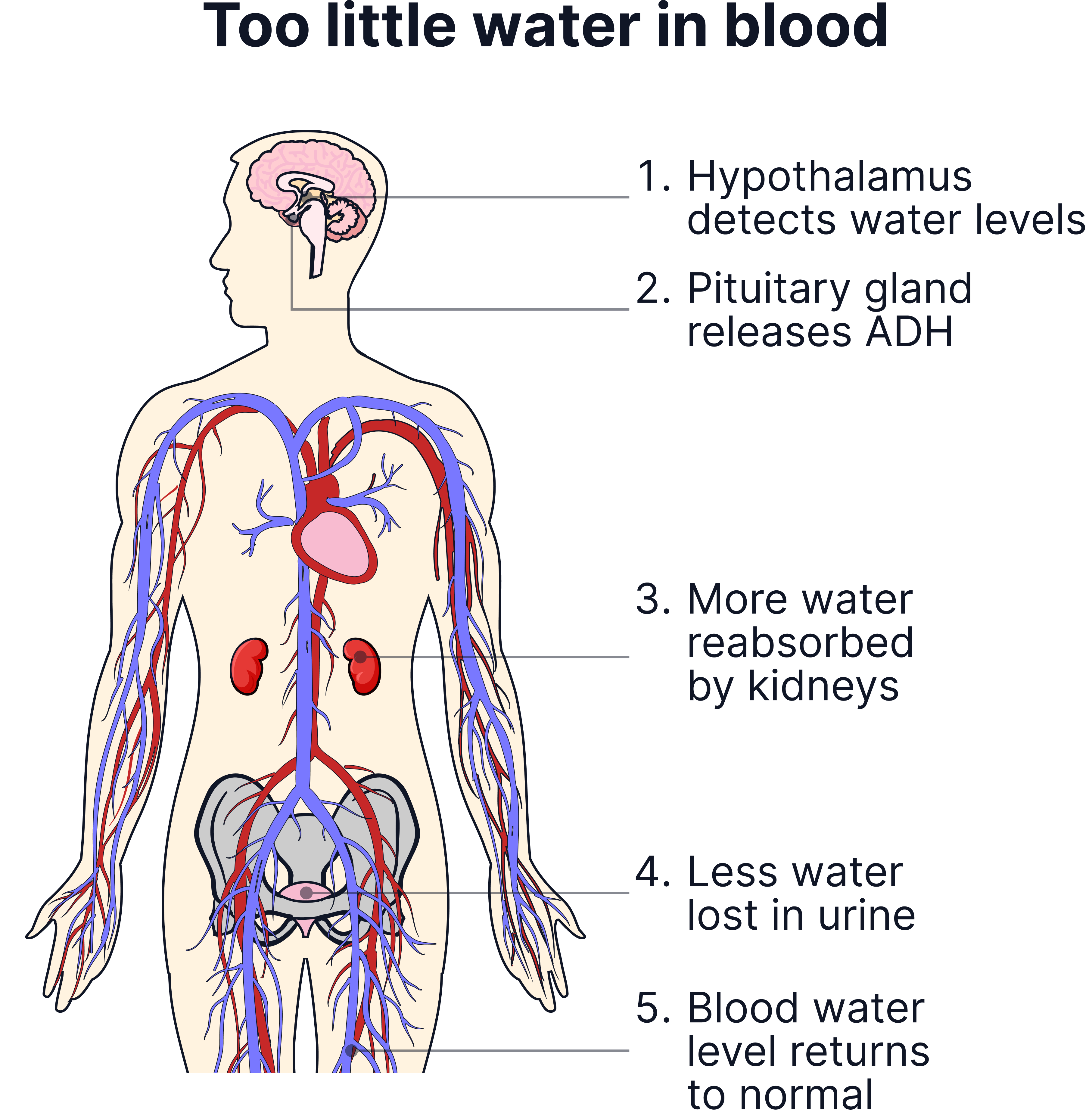
It is released when the blood becomes too concentrated (e.g. after sweating or not drinking enough water).
-
ADH acts on the kidney tubules and increases their permeability to water.
-
This means:
-
More water is reabsorbed from the kidney tubules back into the blood.
-
Less water is lost in urine, so the urine becomes more concentrated and will be produced in smaller volumes.
If the blood is too dilute (contains too much water), less ADH is released so less water is reabsorbed from the kidney tubules. This means urine produced will be more dilute and there will be greater volumes produced.
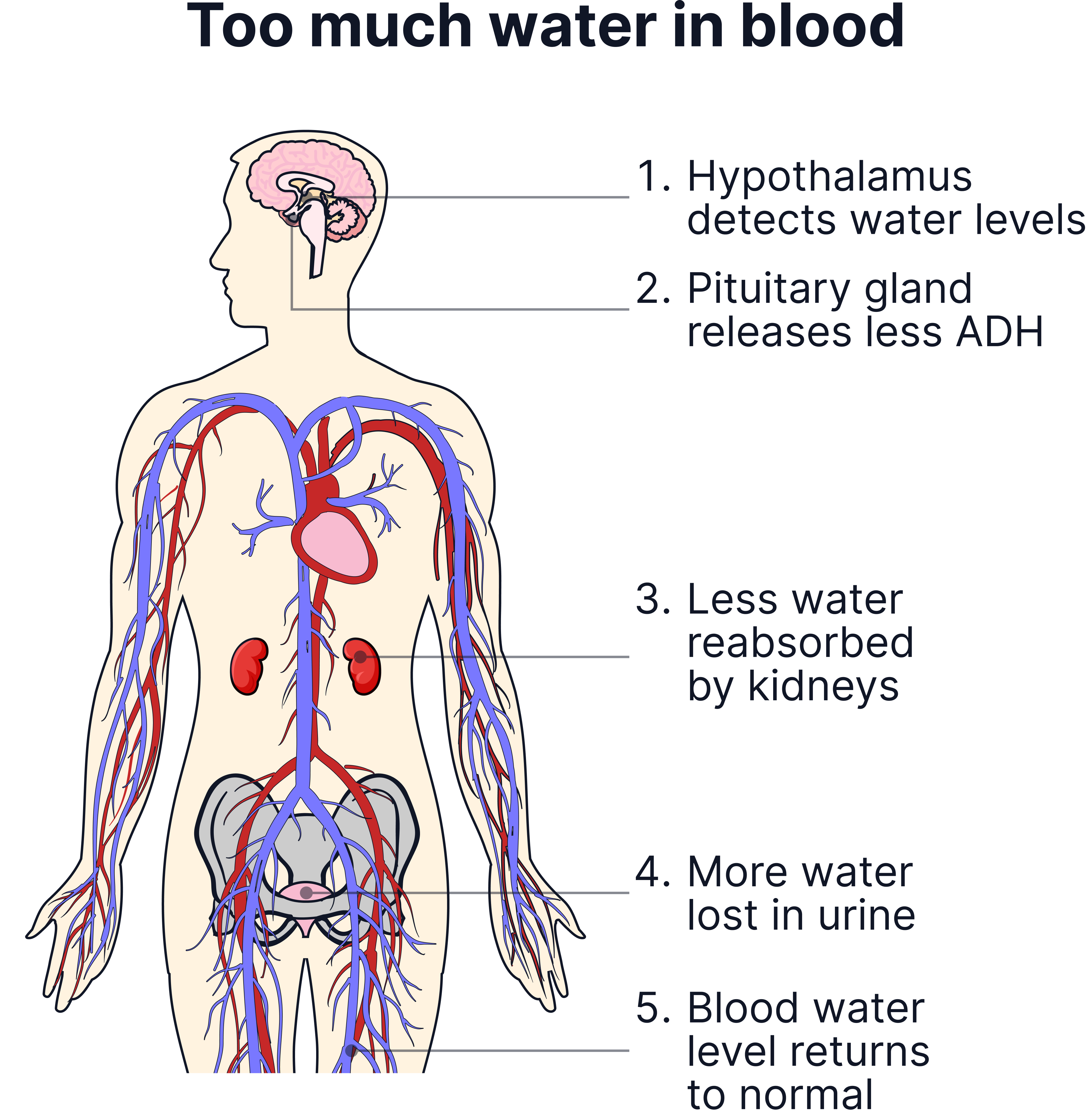
This is an example of negative feedback.
Summary Table – ADH and Water Balance
|
Condition |
ADH Level |
Effect on Kidney Tubules |
Urine Produced |
|---|---|---|---|
|
Blood too concentrated |
ADH increases. |
More water reabsorbed from kidney tubules. |
Small volume, concentrated. |
|
Blood too dilute |
ADH decreases. |
Less water reabsorbed from kidney tubules. |
Larger volume, dilute. |
Negative Feedback
-
ADH release is controlled by negative feedback.
-
This ensures the body maintains a stable internal water balance.
-
When water levels go too high or low, the system reverses the change.
Key Terms
- ADH (Antidiuretic Hormone) - A hormone that controls water balance by acting on kidney tubules.
- Permeability - How easily substances (like water) can pass through a membrane or surface.
- Kidney tubules - Tiny tubes in the kidney where water and other substances are reabsorbed.
- Negative feedback - Any change away from the normal level will cause a response to reverse the change and bring the level back to normal.
- Pituitary gland -Gland in the brain that releases hormones, including ADH.
No answer provided.
Exam Tips
In 4–6 mark questions, make sure to:
-
State where ADH is released from – the pituitary gland
-
Describe its effect (increases permeability of kidney tubules).
-
Explain the result (more water reabsorbed back into the blood, leading to more concentrated urine).
-
Mention negative feedback if the question asks how balance is maintained.
No answer provided.
Practice Question
Explain how ADH affects the production and concentration of urine by the kidneys. (4 marks)
-
increased / high ADH increases the permeability of kidney tubules.
-
increased / high ADH increases water reabsorption from the kidney tubules.
-
so increases the concentration of urine / urine will be more concentrated.
-
and decreases the volume of urine produced.
or
-
decreased/ low ADH decreases the permeability of kidney tubules.
-
decreased / low ADH decreases water reabsorption from the kidney tubules.
-
so decreases the concentration of urine / urine will be more dilute.
-
and increases the volume of urine produced.
More Practice
Try to answer these practice questions from the TikTok videos on your own, then watch the videos to see how well you did!