Absorption in the Small Intestine
Laura Armstrong & Joe Wolfensohn
Teachers


Recall Questions
This topic requires prior knowledge of surface area adaptations and diffusion to understand how nutrients are absorbed into the bloodstream.
Define diffusion?
The net movement of particles from an area of higher concentration to an area of lower concentration
State 4 factors that affect the rate of diffusion?
Temperature, concentration gradient, surface area, diffusion distance
State 1 method to maintain the concentration gradient for oxygen in the alveoli.
Many capillaries / rich blood supply / constant circulation of blood / continuous ventilation
Topic Explainer Video
Check out this @JoeDoesBiology video that explains absorption in the small intestine, then read the study notes. Once you’ve gone through them, don’t forget to try the practice questions!
Absorption in the Small Intestine
What is Absorption?
- Absorption is the movement of digested food molecules (e.g. glucose, amino acids) from the small intestine into the blood.
- These nutrients are then transported around the body for energy, growth, and repair.
Where Does It Happen?
- In the small intestine. The small intestine is very long, this increases the surface area and the time for absorption.
- The lining of the small intestine is covered in projections called villi. Each villus has a folded membrane, the folds are called microvilli. Villi and microvilli massively increase the surface area for absorption.
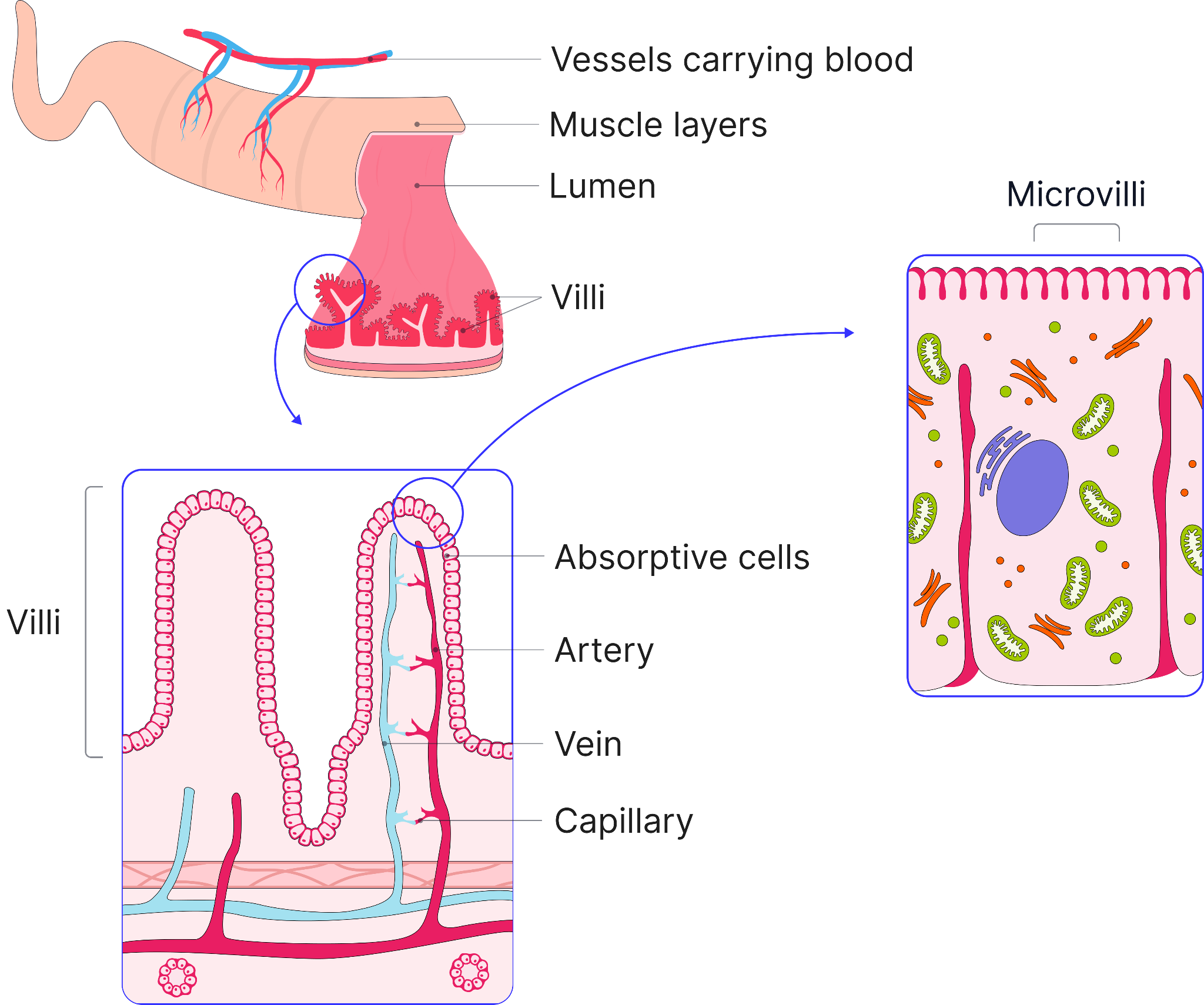
Adaptations of the Small Intestine for Absorption
|
Adaptation |
Explanation |
|
Villi and microvilli |
Increase surface area for faster absorption of nutrients. |
|
1 cell thick walls of the villi |
Short diffusion pathway. |
|
Good blood supply (each villus contains many capillaries) |
Maintains a steep concentration gradient. |
|
Muscular walls |
Keep food moving, maintaining a fresh supply of nutrients close to the intestinal walls. |
|
Many mitochondria in the epithelial cells (the surface cells of the villi) |
Provide energy from respiration for active transport of nutrients. |
|
Very long |
More time for absorption of nutrients to take place. |
Key Terms
- Villi – finger-like projections in the small intestine, increasing surface area.
- Microvilli – Folds of the cell membrane on epithelial cells (the surface cells).
- Epithelial cells - cells that form a surface, for example, the inner surface of the small intestine.
No answer provided.
Exam Tips
- Link the adaptations of the small intestine to the factors that affect the rate of diffusion. This could be a 4-5 mark question in your exam!
- Nutrients such as glucose and amino acids could be absorbed via diffusion or active transport, depending on the concentration of these nutrients inside the small intestine.
No answer provided.
Practice Question
Explain how the small intestine is adapted for efficient absorption. (5 marks)
Model Answer:
- The small intestine has villi and microvilli to increase surface area.
- The walls of the villi are 1 cell thick, so there is a short diffusion distance.
- A good blood supply maintains a steep concentration gradient.
- Many mitochondria in the cells release energy from respiration for active transport.
- The small intestine is long allowing more time for efficient absorption.
More Practice
Try to answer the practice question from the TikTok video on your own, then watch the video to see how well you did!