Hormones In Human Reproduction - The Menstrual Cycle
Laura Armstrong & Joe Wolfensohn
Teachers


Contents
Recall Questions
This topic requires prior knowledge of the endocrine system.
Which gland produces FSH and LH?
The pituitary gland
Which female reproductive hormones are released by the ovaries?
Oestrogen and progesterone
Where is the male hormone testosterone released from?
The testes
Topic Explainer Videos
Check out these @lauradoesbiology and @JoeDoesBiology videos that explain hormones in human reproduction, then read the study notes. Once you’ve gone through them, don’t forget to try the practice questions!
Hormones In Human Reproduction
In males: Testosterone is the main male reproductive hormone produced by the testes and it stimulates sperm production.
In females: Several hormones are involved in the menstrual cycle.
- Follicle stimulating hormone (FSH) causes maturation of an egg in the ovary.
- Luteinising hormone (LH) stimulates the release of the egg.
- Oestrogen and progesterone are involved in maintaining the uterus lining.
Overview of the Menstrual Cycle
- A monthly cycle (about 28 days) preparing the female body for pregnancy.
- Controlled by four key hormones.
- Involves the release of an egg (ovulation) and changes to the lining of the uterus.

Hormones and Their Roles
|
Hormone |
Made By |
Function |
|
FSH |
Pituitary gland |
Stimulates maturation of an egg in the ovary. Stimulates oestrogen release. |
|
Oestrogen |
Ovaries |
Causes the lining of the uterus to thicken. Inhibits FSH. Stimulates LH. |
|
LH |
Pituitary gland |
Triggers ovulation (release of the egg from the ovary) around day 14 of the menstrual cycle. |
|
Progesterone |
Ovaries (after ovulation- from the corpus luteum) |
Maintains the uterus lining ready for implantation. Inhibits FSH and LH. If there is no pregnancy, progesterone levels drop and the uterus lining breaks down. |
Hormonal Coordination Summary
- Day 1–14: FSH increases, egg matures, oestrogen thickens the uterus lining.
- Around Day 14: LH spikes, triggering ovulation - the egg cell is released from the ovary.
- Day 14–28: Progesterone keeps the uterus lining thick. If the egg is not fertilised, hormone levels drop, and menstruation occurs.
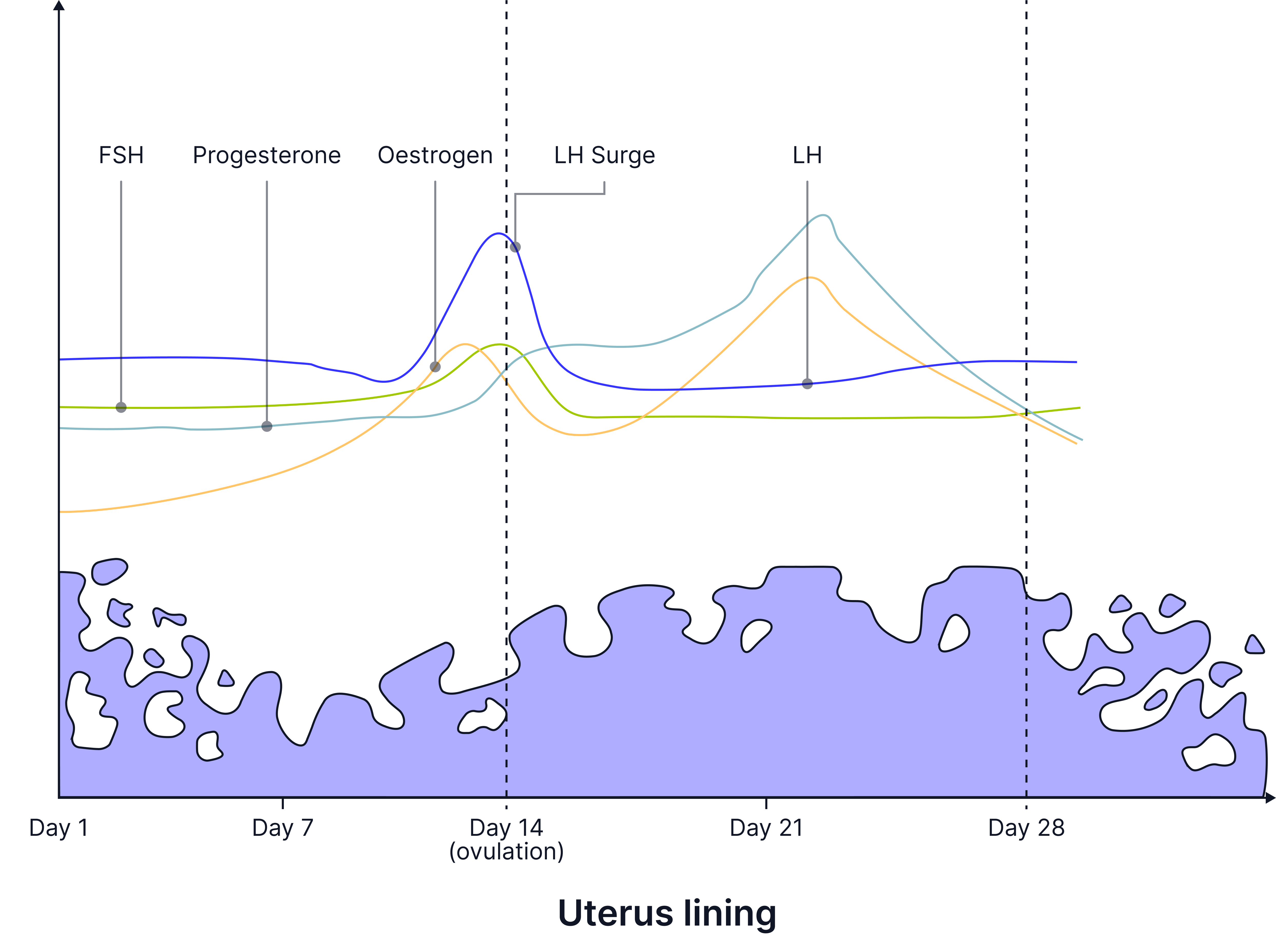
Higher tier only
You need to be able to explain the interactions of FSH, oestrogen, LH and progesterone, in the control of the menstrual cycle.
- FSH stimulates oestrogen release from the ovaries, this is so the uterus lining starts to thicken.
- Oestrogen inhibits FSH, this is so only 1 egg matures in the ovaries.
- Oestrogen stimulates LH release from the pituitary gland, so ovulation occurs around day 14.
- Progesterone inhibits both FSH and LH, so multiple eggs do not mature and multiple eggs do not get released from the ovaries. This should prevent multiple pregnancies which can be dangerous for both mother and babies.
No answer provided.
Key Terms
- Ovulation: Release of an egg from an ovary around day 14 of the menstrual cycle.
- FSH: Follicle-Stimulating Hormone – matures the egg in the ovary.
- LH: Luteinising Hormone – triggers ovulation.
- Oestrogen: Builds up the uterus lining.
- Progesterone: Maintains the uterus lining.
- Inhibits: To block or prevent.
- Corpus luteum: The empty follicle that remains in the ovaries after the egg has been released during ovulation - it releases progesterone.
No answer provided.
Exam Tips
Use hormone names clearly and state where they are released from as well as their effect.
Remember FOLP to get the order of hormones correct.
FSH – Oestrogen – LH – Progesterone
No answer provided.
Practice Questions
Describe the sequence of hormone interactions in the menstrual cycle.
Name where each hormone is produced. (5)
Model Answer:
any five from:
• FSH from the pituitary stimulates an egg / follicle to mature.
• FSH stimulates oestrogen from the ovaries.
• oestrogen causes thickening of the uterus lining .
• oestrogen inhibits FSH but stimulates LH from the pituitary.
• the high levels of LH stimulate release of the egg / ovulation (on day 14).
• progesterone is secreted by the ovaries / corpus luteum.
• progesterone maintains the lining of the uterus or progesterone inhibits both FSH and LH.
• progesterone falls (if no pregnancy happens) and uterus lining comes away as the menstrual blood flow
More Practice
Try to answer the practice question from the TikTok video on your own, then watch the video to see how well you did!