Required practical - The effect of light intensity on the rate of photosynthesis
Laura Armstrong & Joe Wolfensohn
Teachers


Contents
Recall Questions
This topic requires prior knowledge of limiting factors and photosynthesis.
What are the three main limiting factors of photosynthesis?
Light intensity, temperature, and carbon dioxide concentration.
What is a limiting factor?
A factor that, when increased, will increase the rate of photosynthesis.
Why does photosynthesis slow down in cold temperatures?
Because the enzymes work more slowly at low temperatures. This is due to them having less kinetic energy and there being fewer enzyme-substrate complexes formed.
Topic Explainer Video
Check out this @JoeDoesBiology video that explains the effect of light intensity on the rate of photosynthesis, then read the study notes. Once you’ve gone through them, don’t forget to try the practice questions!
Aim of this investigation
To investigate how light intensity affects the rate of photosynthesis in pondweed (Elodea).
Method:
-
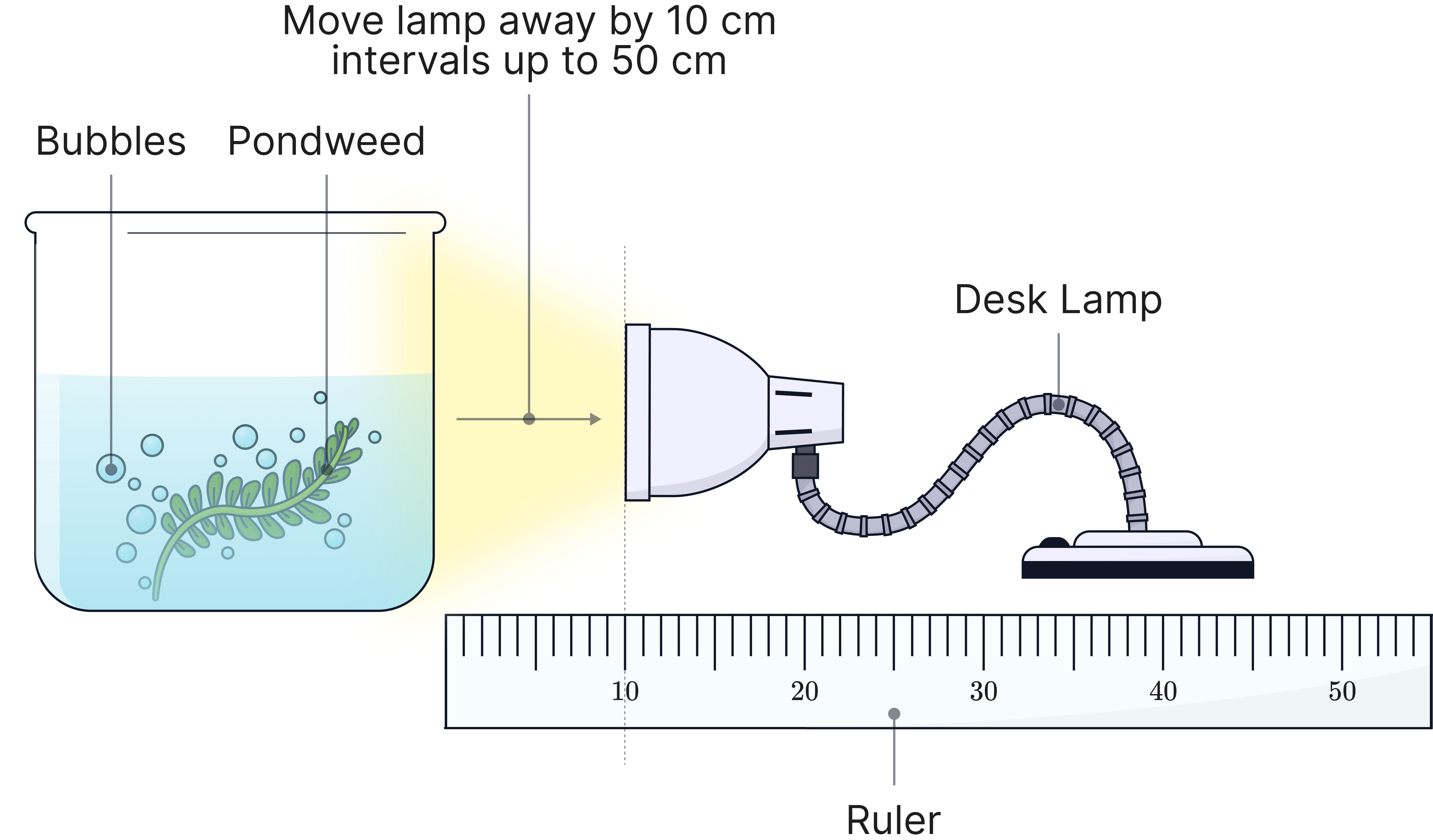
Set up the apparatus:
-
A beaker filled with water and sodium hydrogen carbonate (to release CO₂ for photosynthesis).
-
A piece of Elodea placed in the solution.
-
A lamp placed at a set distance from the plant.
-
A ruler to measure the distance between the lamp and the Elodea.
-
A stopwatch to time the investigation.
-
Change the distance of the lamp from the plant (e.g. 10 cm, 20 cm, 30 cm, 40 cm and 50 cm).
-
Count the number of bubbles of oxygen produced in 1 minute.
-
Repeat each distance a minimum of three times for reliability and to calculate the mean number of bubbles per minute.
Key Variables
-
Independent variable: Distance of the lamp from the plant (affecting light intensity).
-
Dependent variable: Rate of photosynthesis (measured by the number of bubbles produced per minute). We assume these bubbles are oxygen bubbles as oxygen is produced in photosynthesis.
-
Controlled variables:
-
Temperature (conduct the experiment at room temperature)- you can use a Perspex block as a heat shield between the lamp and the pondweed to absorb any heat energy released from the light. You can also use an LED bulb in the lamp as this does not release heat energy.
-
CO₂ concentration (use the same volume of sodium hydrogen carbonate in the beaker).
-
Same piece or same size of Elodea (same length).
-
Time measured (e.g. always count for 1 minute).
-
Same light source and wattage.
No answer provided.
Results
-
As the lamp gets closer, light intensity increases.
-
This leads to more bubbles of oxygen, showing a higher rate of photosynthesis.
-
Beyond a point, another limiting factor (like CO₂ or temperature) may limit the rate.
No answer provided.
Limitations of Counting Bubbles
-
Inconsistent bubble size: Larger bubbles contain more oxygen, but the method doesn’t account for this.
-
Difficult to count quickly: At high rates of photosynthesis, bubbles can be too fast to count accurately.
No answer provided.
Improvement: Use of a Gas Syringe
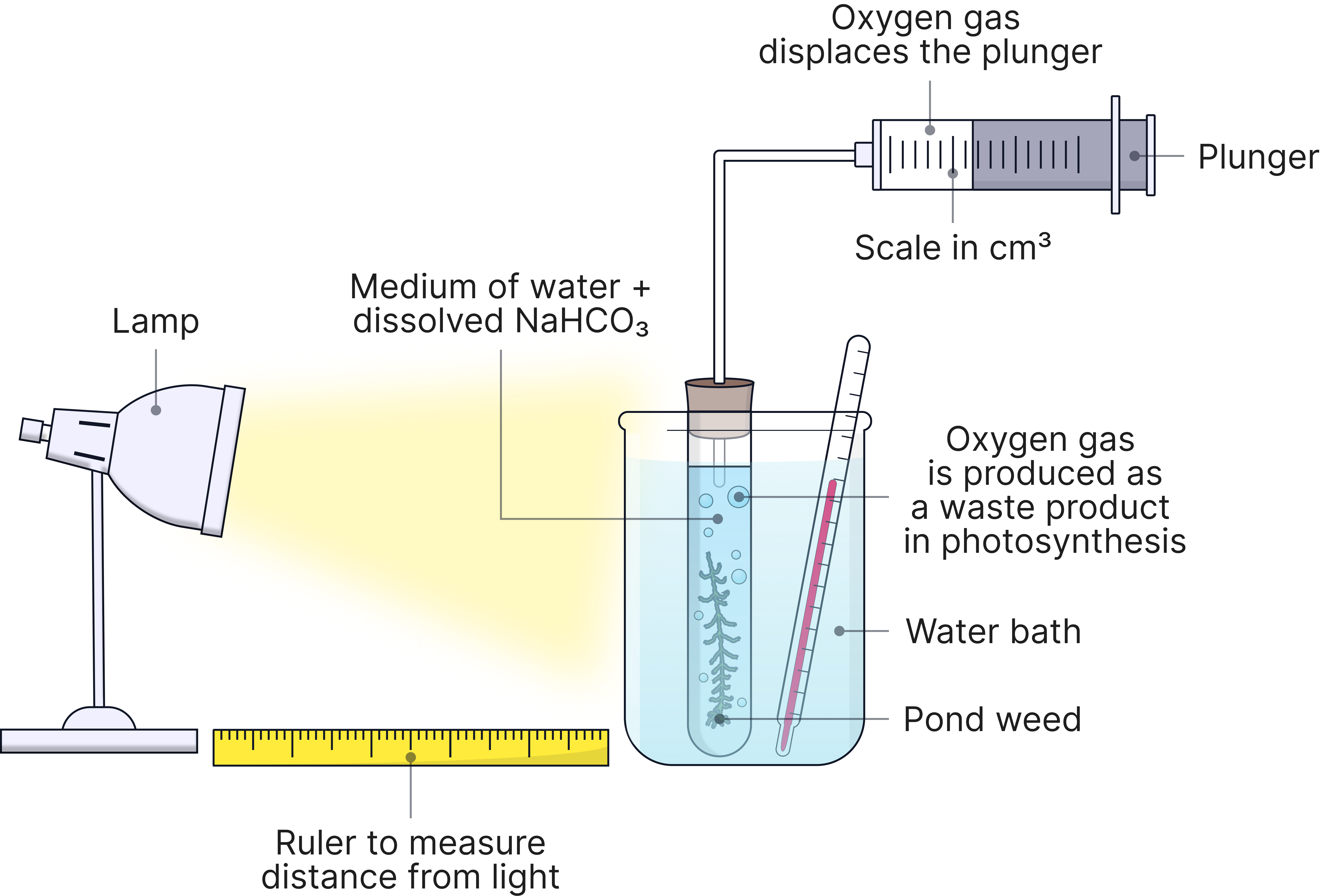
Instead of counting bubbles of oxygen released by Elodea, we can collect and measure the volume of oxygen gas using a gas syringe.
Advantages of Using a Gas Syringe
-
More accurate: Measures the actual volume of oxygen produced rather than estimating.
-
Consistent and quantitative: Gives numerical data for volume of oxygen in cm³.
-
Reduces human error: Doesn’t rely on visual counting, where observers may miscount bubbles.
Higher Tier Only
What Is the Inverse Square Law?
In biology, the inverse square law explains how light intensity decreases as distance from a light source increases.
The relationship is:
Where:
-
d = distance from the light source (in cm or m)
How Does It Link to Photosynthesis?
-
Light is a limiting factor for photosynthesis.
-
If light intensity increases, the rate of photosynthesis increases (up to a point).
-
As a lamp is moved further away, light intensity drops sharply (according to the inverse square law), so the rate of photosynthesis decreases.
|
Distance from Light Source (cm) |
Distance² (cm²) |
Light Intensity (arbitrary units) |
|
10 cm |
100 |
1 / 100 = 0.01 |
|
20 cm |
400 |
1 / 400 = 0.0025 |
|
40 cm |
1600 |
1 / 1600 = 0.000625 |
- Light intensity and distance are inversely related – when distance doubles, light intensity drops to a quarter.
No answer provided.
Alternative Independent Variables for the Photosynthesis Practical
In Required Practical 5, the independent variable is usually light intensity, but other factors that affect the rate of photosynthesis can also be investigated.
1. Temperature
How it affects photosynthesis:
-
Affects the activity of enzymes involved in photosynthesis.
-
Too low = enzymes work slowly.
-
Too high = enzymes may denature, reducing the rate.
How to vary it:
-
Place the beaker containing the Elodea in water baths at different temperatures (e.g. 10°C, 20°C, 30°C, 40°C, 50°C).
-
Keep the lamp distance, CO₂ concentration, and plant size/length the same.
Equipment needed:
-
Water baths or warm water and ice to adjust temperatures.
-
Thermometer to monitor temperature accurately.
2. Carbon Dioxide Concentration
How it affects photosynthesis:
-
CO₂ is a reactant for photosynthesis.
-
More CO₂ = more substrate = faster rate of reaction.
How to vary it:
-
Use different concentrations of sodium hydrogen carbonate in the water (e.g. 0.1%, 0.25%, 0.5%, 1.0% solutions).
-
Keep temperature, light distance, and size of plant constant.
Method:
-
Make up sodium hydrogen carbonate solutions at different concentrations.
-
Add the same volume of each solution to the beaker with Elodea.
-
Measure the rate of photosynthesis using either bubble count or gas syringe.
3. Light Colour (Wavelength)
How it affects photosynthesis:
-
Chlorophyll absorbs red and blue light best; green light is reflected.
-
Different colours may produce different rates of photosynthesis.
How to vary it:
-
Use coloured filters (e.g. red, blue, green, yellow) between the lamp and the plant.
-
Use the same lamp intensity, same distance, and same plant species/ size.
Note: This investigates wavelength/colour of light rather than light intensity.
Key Terms
- Independent variable - The variable you change (e.g. distance of lamp / light intensity).
- Dependent variable - What you measure (rate of photosynthesis).
- Controlled variables - Things you keep the same so they do not affect the rate of photosynthesis.
- Sodium hydrogen carbonate - Chemical used to release a constant CO₂ source.
No answer provided.
Exam Tip
If asked how to improve the practical or increase accuracy:
"Use a gas syringe to measure the volume of oxygen produced rather than counting bubbles, as it provides more accurate, quantitative data."
No answer provided.
Practice Question
A student investigated the effect of light intensity on the rate of photosynthesis using pondweed. Describe how the student could carry out this investigation. Include the variables that need to be controlled. (6 marks)
-
Place Elodea in a beaker of water with sodium hydrogen carbonate to provide CO₂ (1).
-
Use a lamp and a ruler to change the distance from the plant (1).
-
Use at least 5 different distances so 5 different light intensities are investigated (1).
-
Count the number of bubbles produced in 1 minute at each distance (1).
-
Repeat each distance three times and calculate a mean (1).
-
Keep temperature, volume of sodium hydrogen carbonate, size of Elodea, and time measured the same (1).
More Practice
Try to answer these practice questions from the TikTok videos on your own, then watch the videos to see how well you did!