Sex Determination
Laura Armstrong
Teacher

Contents
Recall Questions
This topic requires prior knowledge of punnett squares and chromosomes.
How many pairs of chromosomes are in a human body cell?
23 pairs of chromosomes
Which pair of chromosomes determines biological sex?
The 23rd pair (sex chromosomes)
What are the sex chromosomes in a female and a male?
Female: XX, Male: XY
Topic Explainer Video
Check out this @lauradoesbiology video that explains sex determination, then read the study notes. Once you’ve gone through them, don’t forget to try the practice questions!
Sex Determination
What Is Sex Determination?
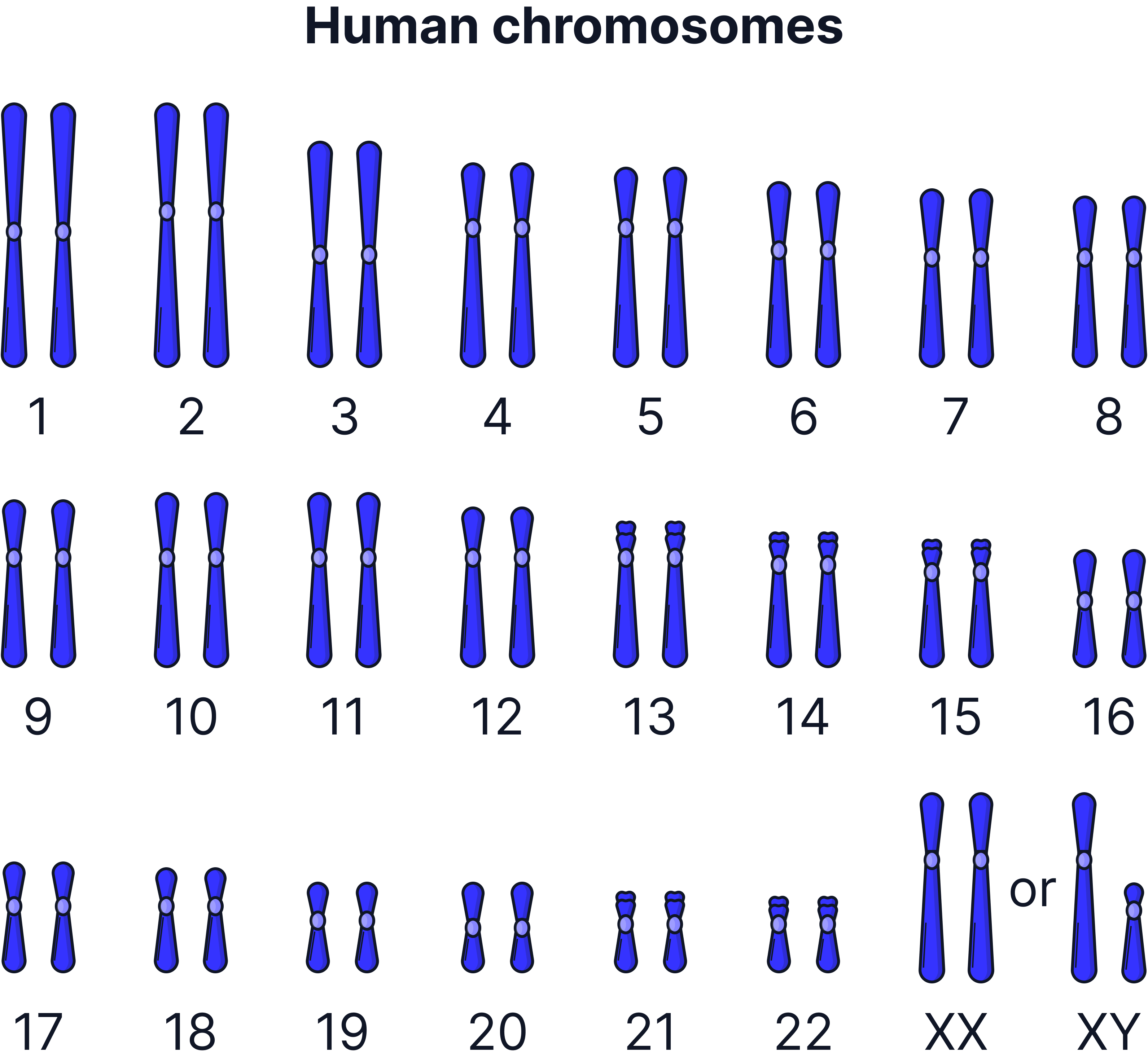
- Humans have 23 pairs of chromosomes (46 in total) in every body cell.
- 22 pairs control general characteristics (e.g., eye colour, height).
- The 23rd pair are the sex chromosomes, which determine an individual's biological sex:
- Females: Have two X chromosomes - XX.
- Males: Have one X and one Y chromosome – XY.
Genetic Cross for Sex Determination
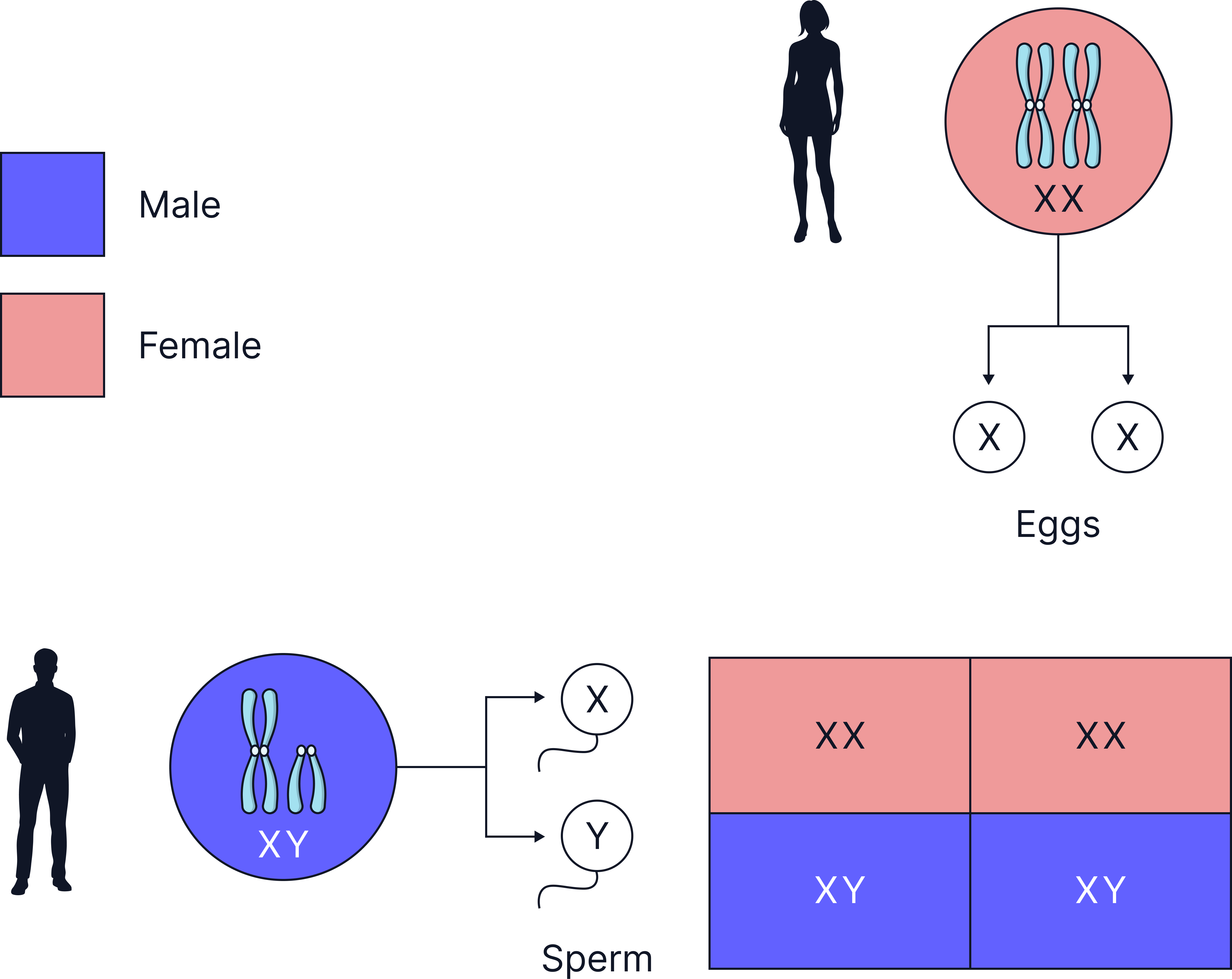
A Punnett square can be used to predict the biological sex of offspring:
Parent Genotypes:
- Mother (XX)
- Father (XY)
Gametes:
- Mother can only pass on X in her egg cell.
- Father can pass on X or Y in his sperm cell.
|
X (in egg cell) |
X (in egg cell) |
|
|
X (in sperm cell) |
XX (girl) |
XX (girl) |
|
Y (in sperm cell) |
XY (boy) |
XY (boy) |
Outcomes:
- 2 XX (female)
- 2 XY (male)
Ratio of Male to Female = 1:1
Probability of a boy = 2 out of 4 = 50%
Probability of a girl = 2 out of 4 = 50%
Key Terms
- Chromosome – Thread-like structure in the nucleus made of DNA.
- Sex chromosome – The 23rd pair that determines sex (XX or XY).
- XX – Female sex chromosomes.
- XY – Male sex chromosomes.
- Gamete – A sex cell (egg or sperm), each carrying one sex chromosome.
No answer provided.
Exam Tips:
Even if a couple has already had five daughters, the probability that their next child will be a boy or a girl is still 50/50.
Here’s why:
- Sex is determined by the sperm cell, which can carry either an X or a Y chromosome.
The egg always carries an X chromosome. - When an X sperm fertilises the egg → girl (XX)
- When a Y sperm fertilises the egg → boy (XY)
Each fertilisation is a separate, random event, like flipping a coin.
The outcome of previous children does not affect the outcome of the next one.
It’s like flipping a coin five times and getting heads each time – the chance of heads or tails on the next flip is still 50%.
No answer provided.
Practice Question
Q: A couple is expecting a baby. Use a genetic diagram to show the probability that the baby will be male. (4 marks)
Model Answer:
|
X |
X |
|
|
X |
XX (girl) |
XX (girl) |
|
Y |
XY (boy) |
XY (boy) |
- 2 offspring are XX (female), 2 are XY (male)
- Therefore, the probability of a male baby = 2 out of 4 = 50% or 1/2
More Practice
Try to answer the practice question from the TikTok video on your own, then watch the video to see how well you did!