Predator and prey cycles
Laura Armstrong & Joe Wolfensohn
Teachers


Recall Questions
This topic requires prior knowledge of food chains and webs.
What is a predator?
A consumer that kills and eats other animals.
What is prey?
Animals that are eaten by predators.
What does a food chain show?
The feeding relationships between organisms and the transfer of energy.
Topic Explainer Video
Check out this @JoeDoesBiology video that explains predator and prey cycles, then read the study notes. Once you’ve gone through them, don’t forget to try the practice questions!
What Are Predators and Prey?
-
A predator is an animal that hunts, kills, and eats other animals.
-
The animal that is eaten is called the prey.
Example:
-
A fox (predator) hunts and eats rabbits (prey).
Predator and prey numbers are both biotic factors.
Here’s why:
-
Biotic factors are the living parts of an ecosystem that can affect other organisms.
-
Predators and prey are living organisms, so they are biotic factors.
-
For example:
-
Predators can affect prey population sizes (e.g., more foxes → fewer rabbits).
-
Prey numbers can affect predator population sizes (e.g., lots of rabbits → more food for foxes).
Key Adaptations of Predators
Predators have adaptations to help them hunt, catch, and kill their prey, such as:
- Sharp teeth and claws - to catch, hold, and kill prey (e.g. lions, foxes).
- Forward-facing eyes - for good depth perception and judging distance.
- Fast and agile bodies - to chase and catch prey.
- Camouflage - to sneak up on prey without being seen (e.g. tigers in long grass).
- Good senses - excellent hearing, smell, or night vision to locate prey.
- Venom or powerful jaws - in some species, to subdue prey quickly (e.g. snakes).
Key Adaptations of Prey
Prey animals have adaptations to help them detect predators and escape, such as:
- Eyes on the side of their head - gives a wide field of view to spot predators early.
- Camouflage colouring - to blend in and avoid being seen (e.g. white snowshoe hares in the snow and ice).
- Fast and agile - able to run, hop, or fly away quickly.
- Live in groups / herds - ‘safety in numbers’ helps spot predators sooner.
- Warning signals - some prey have bright colours to warn they’re poisonous (e.g. ladybirds).
- Mimicry - some prey mimic more dangerous animals (e.g. harmless hoverflies that look like wasps, so predators believe they may sting them).
Predator–Prey Cycles in a Stable Community
-
In a stable community, the numbers of predators and prey go up and down in linked cycles.
-
The cycle happens because the populations depend on each other.
How it works:
-
Plenty of prey → predator numbers increase
There is lots of food, so more predators survive and reproduce. -
More predators → prey numbers fall
More predators means more prey are eaten. -
Fewer prey → predator numbers fall
Less food means some predators starve or don’t reproduce. -
Fewer predators → prey numbers rise again
With fewer predators hunting them, the prey population recovers. -
The cycle repeats.
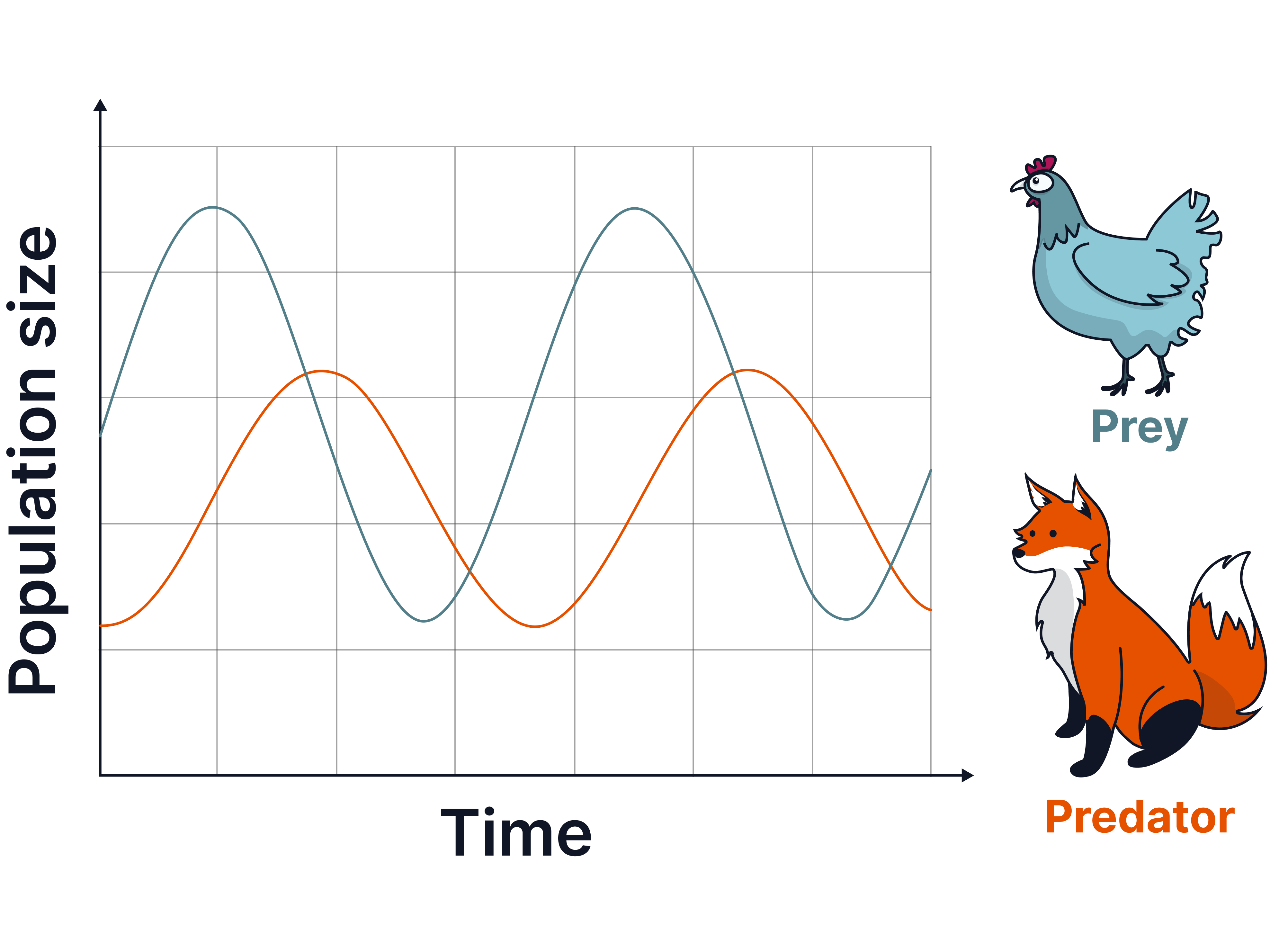
How to Interpret a Predator–Prey Graph
When you see a predator–prey graph:
-
The prey population always peaks before the predator population.
-
This is because predators take time to grow, reproduce and raise young, the predator population increases after the prey population peaks.
Key Terms
-
Predator – An animal that hunts and eats other animals.
-
Prey – An animal that is eaten by a predator.
-
Food chain – Shows how energy is transferred from one organism to another.
-
Cycle – A pattern that repeats over time.
-
Stable community – A balanced ecosystem where population sizes stay fairly constant in the long term.
No answer provided.
Exam Tip
If provided with a graph that has a numerical scale, try to give data where you can, you may be able to give the number of predators / prey during a particular year and compare this to the number in another year.
No answer provided.
Practice Question
Lynx are the main predators of snowshoe hares. Snowshoe hares are the main prey of lynx.
Another predator of snowshoe hares is the wolf. Wolves feed on a wide variety of prey, not just snowshoe hares.
When the number of snowshoe hares decreases, the number of lynx will also decrease. Predict what would happen to the number of wolves when the population of snowshoe hares decreases. Explain your answer. (2)
Decrease in number of wolves as they have less food / less prey / fewer snowshoe hares to eat (1)
but a smaller decrease / not so dramatic because wolves have other prey (1)
OR
No decrease in wolves / no effect (1)
because wolves will eat other prey instead (1)
More Practice
Try to answer the practice question from the TikTok video on your own, then watch the video to see how well you did!