Required practical - Reaction time
Laura Armstrong & Joe Wolfensohn
Teachers


Recall Questions
This topic requires prior knowledge of reflex actions.
What is a reflex action?
An automatic and rapid response that does not involve the conscious part of the brain.
What is the function of a relay neurone?
It connects the sensory neurone to the motor neurone in the CNS.
What is a synapse?
A small gap between neurones where chemicals diffuse across to trigger an electrical impulse in the next neurone.
Topic Explainer Videos
Check out these @Lauradoesbiology and @JoeDoesBiology videos that explain reaction time, then read the study notes. Once you’ve gone through them, don’t forget to try the practice questions!
Definition of Reaction Time
Reaction time is the time taken to respond to a stimulus.
Typical human reaction times are between 0.2 and 0.3 seconds.
Factors that Affect Reaction Time
-
Caffeine
-
Age
-
Tiredness
-
Practice / training
-
Distractions
-
Use of drugs or alcohol
Investigating Human Reaction Time
Aim
To investigate how a factor (e.g. caffeine or distractions) affects human reaction time.
Example Method 1 – Effect of Caffeine on reaction time
Method:
-
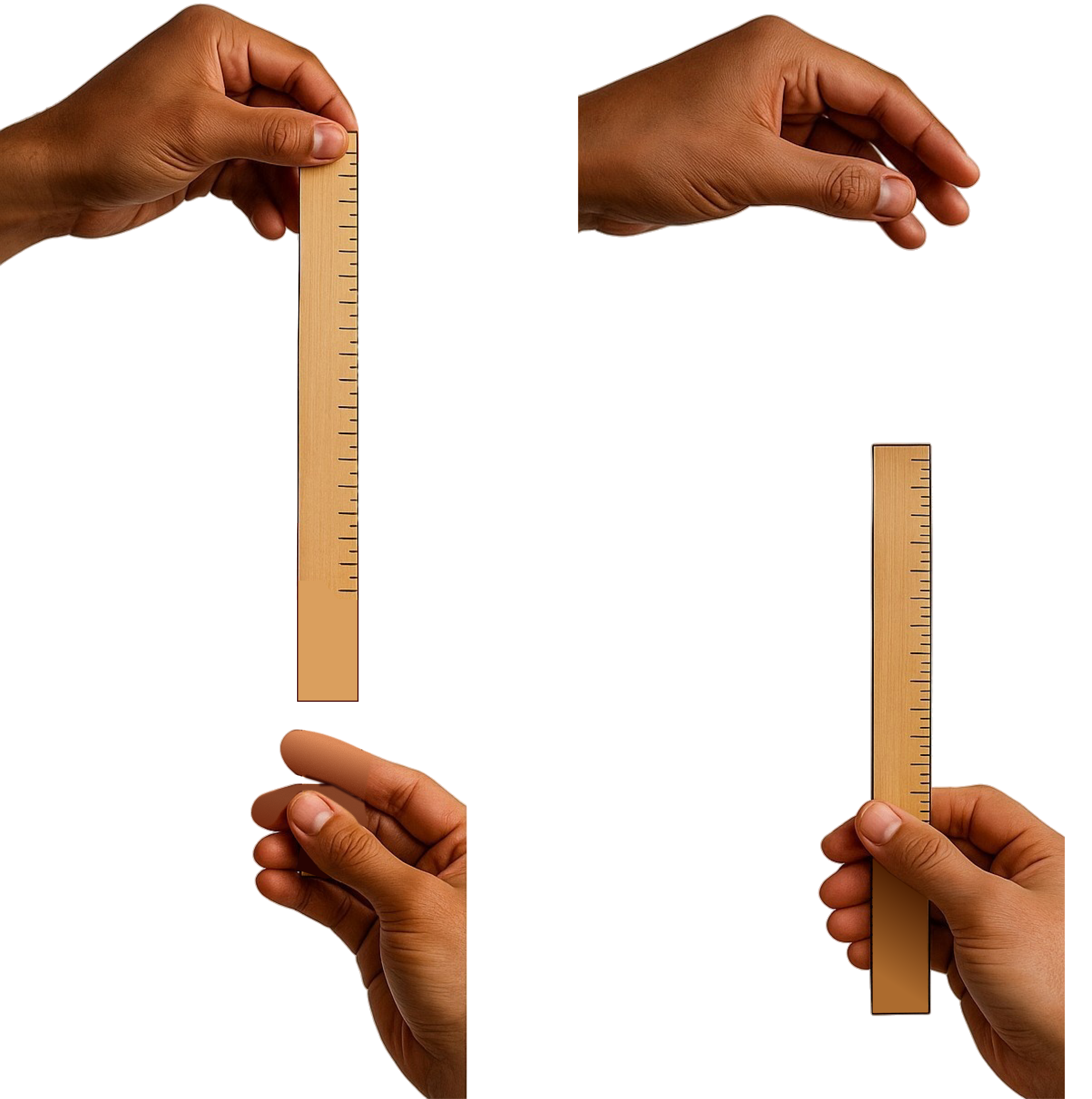
Have the test subject sit with their arm resting on a table.
-
Hold a ruler vertically just above the subject’s thumb and forefinger, with the 0 cm mark level with the thumb.
-
Drop the ruler without warning.
-
Record where the ruler is caught.
-
Repeat three times and calculate a mean.
-
Look up the reaction time that corresponds to where they caught the ruler- this can be found in a table online.
-
Give the subject a caffeinated drink (e.g. cola), wait 15 minutes.
-
Repeat steps 1–6.
-
Compare mean reaction times before and after caffeine.
-
Repeat this investigation on a large number of people and compare the overall mean reaction times before and after drinking caffeine.
Independent variable: Whether or not the participant has consumed caffeine.
Dependent variable: Reaction time (measured using the ruler drop method).
Control variables:
-
Ruler dropped from same height each time.
-
Same time of day so the person is not tired.
-
Same dominant hand used e.g., right hand if right-handed.
-
Same conditions (lighting, noise) so distractions do not affect the reaction time.
-
Same volume of cola for all participants.
-
Same time left after drinking cola before doing the test is taken.
Example Method 2 – Effect of Distraction on reaction time
Method:
-
Use a computer programme to test reaction time- where the participant has to click a button as soon as the screen changes colour, for example.
-
Do this under quiet conditions three times.
-
Calculate a mean reaction time.
-
Now repeat the test with loud music playing in the background.
-
Repeat three times with the music and calculate a mean reaction time.
-
Compare the reaction times in both conditions.
-
Repeat this investigation on a large number of people and compare the overall mean reaction times with and without the music.
Independent variable: Presence or absence of a distraction (e.g. loud music playing).
Dependent variable: Reaction time (measured using a computer programme).
Control variables:
-
Use the same computer programme each time.
-
Same time of day so the person is not tired.
-
Same dominant hand used to click the button.
-
Same volume of music when played.
-
No other distractions during the test (apart from the music).
Key Terms
-
Reaction time - The time it takes to respond to a stimulus.
-
Reflex - Automatic, fast response that protects the body.
-
Stimulus - A change in the environment.
-
Response - The action taken due to a stimulus.
No answer provided.
Exam Tips
- Always identify the independent, dependent, and control variables clearly in practical questions.
- Remember to calculate the mean after taking repeated measurements.
- The larger the sample size used in an investigation- the more reliable the mean will be.
No answer provided.
Practice Question
A student investigates the effect of listening to music on reaction time using the ruler drop method. Describe how the student should carry out the investigation to ensure valid results. (6 marks)
-
The student should sit with their arm resting on a table and have a partner hold a ruler above their hand.
-
The ruler should be dropped without warning and the student should catch it as quickly as possible.
-
Measure the point at which the ruler is caught and record it.
-
Repeat three times and calculate the mean reaction time.
-
Repeat the experiment three times while playing music and calculate a mean reaction time.
-
Compare the reaction time when quiet vs. music playing to test the effect of distraction.
-
Repeat on a large number of participants.
-
Control variables: same height ruler is dropped from, always use dominant hand, same volume of music, same lighting, same time of day and same level of any other distractions.
Always try to give at least three control variables as these make the results more valid.
More Practice
Try to answer these practice questions from the TikTok videos on your own, then watch the videos to see how well you did!